On this page
- Gross, modified gross and triple net leases: who pays what
- Lease administration: rent steps, options and critical dates
- How CAM reconciliation works
- Percentage rent, tenant billing and deposits
- Insurance, maintenance, budgets and owner reporting
- Commercial property management software compared (October 2026)
- How to choose: checklist and demo script
- Switching platforms: abstracts, opening balances and recoveries in progress
- When a custom tenant or owner portal pays off
Commercial property management software has to do four jobs that residential tools treat as edge cases. It administers long, negotiated leases: rent steps, renewal options and critical dates. It bills and reconciles expense recoveries, the share of CAM, taxes and insurance each tenant repays under its lease. It calculates percentage rent from retail tenants' sales. And it reports to owners and investors entity by entity. If a platform can't run a year-end CAM reconciliation with caps and exclusions without a spreadsheet on the side, it isn't commercial software, whatever the website says.
Portfolio size decides the shortlist. As of October 2026, Yardi Breeze lists commercial at $2 per unit per month with a $200 minimum, and residential-first platforms such as Buildium and AppFolio list commercial support too. Mid-size portfolios should compare Yardi Breeze Premier, Rent Manager and AppFolio, all quoted on request. Large office, retail and industrial portfolios are the territory of Yardi Voyager and MRI, which pair lease administration with full accounting, with VTS as an optional leasing layer that integrates with both.
This is the commercial deep dive; for residential features, trust accounting and the wider vendor list, see our property management software overview. We build custom software, so we'll also say when a custom portal earns its cost. Usually, the right platform and clean lease data matter more.
Gross, modified gross and triple net leases: who pays what
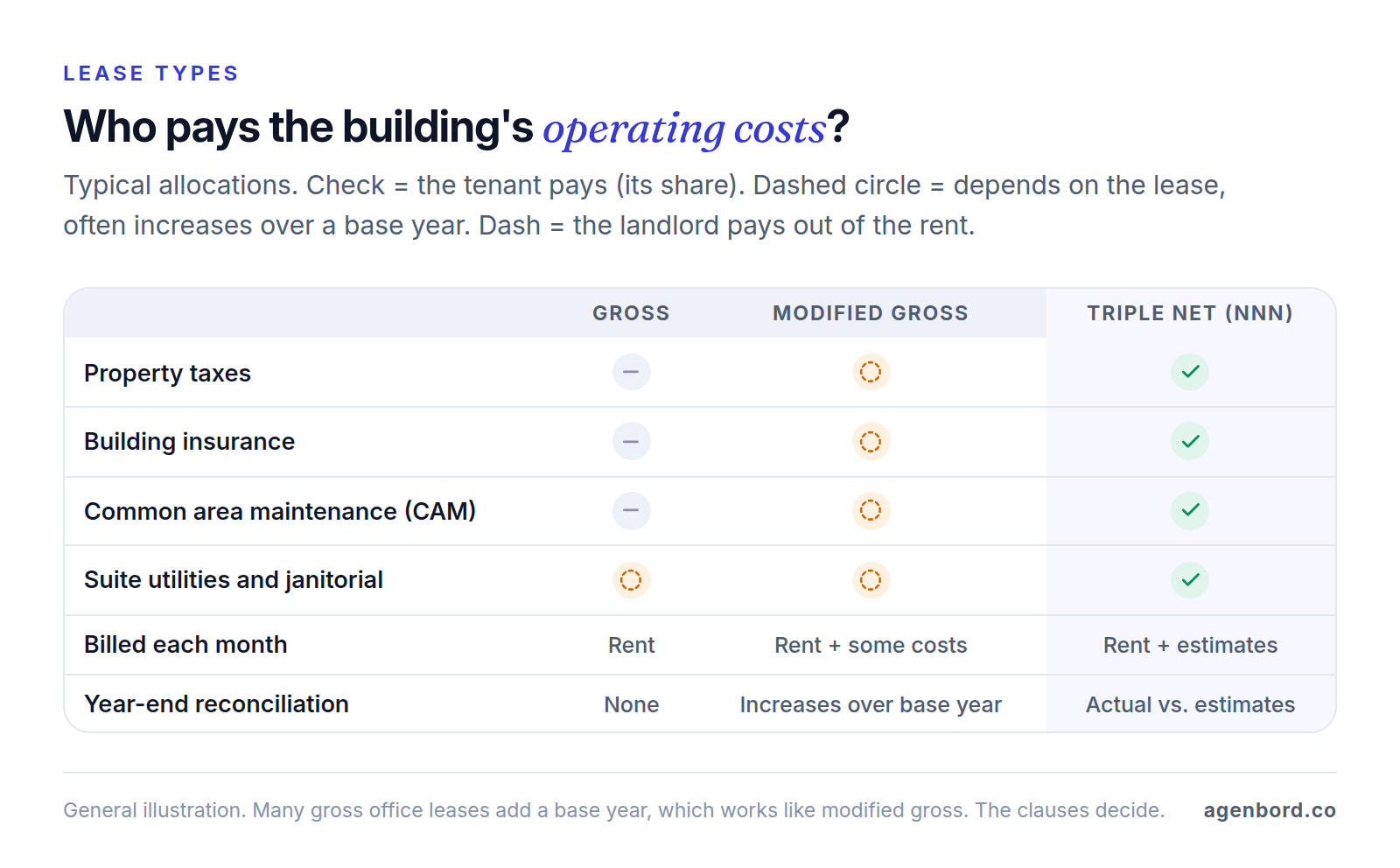
Every commercial lease has base rent. What changes is who pays the building's operating costs: property taxes, insurance and common area maintenance (CAM), meaning the cleaning, landscaping, security, repairs and management of shared areas. That decides what the software bills each month and what it reconciles after year end.
- Gross. The rent includes operating costs, and the landlord pays them. In multi-tenant office the usual version is full service gross, which typically covers utilities and janitorial too.
- Modified gross. The middle ground. The tenant pays some costs directly (often its own utilities and janitorial), its share of increases over a base year (the costs of a set year, usually the first, built into the rent), or both.
- Triple net (NNN). The tenant pays base rent plus its share of taxes, insurance and CAM, as monthly estimates that the landlord trues up against actual costs after year end. It's common in retail and industrial.
Labels are loose: many full service gross office leases add a base-year clause, and some NNN leases cap what the tenant pays. So the software follows the clauses, not the name, storing for each lease its expense pools, share, any base year or expense stop (a fixed cost level per square foot), caps and exclusions. One mixed-use building can hold all three structures.
Lease administration: rent steps, options and critical dates
Lease administration turns each signed lease, amendments included, into data and dates the system acts on.
Rent steps. Increases can be fixed amounts, fixed percentages (a 3% step takes $28.00 a square foot to $28.84) or tied to the Consumer Price Index, often with a floor and a ceiling. Add the free-rent months and abatements negotiated at signing. The system should hold the rent schedule for the whole term, post each step on its effective date and show the schedule when a tenant questions an invoice.
Options and critical dates. Renewal, expansion and termination options, and rights of first offer or refusal on neighboring space, each carry a notice window. Add expirations, expiry dates for letters of credit and insurance certificates, the deadline your leases set for delivering annual reconciliations, and the window tenants have to audit them. Put every date on one calendar with an owner and reminders, not in a spreadsheet one person maintains, and record what each tenant exercised.
All of it comes from the lease abstract, the structured summary of the terms that drive money and deadlines. Whatever platform you choose, abstract every lease to the same standard:
- Parties and guarantors, premises, rentable square feet and pro-rata share
- Commencement, expiration and the full rent schedule, abatements included
- Recovery terms: pools, share and denominator, base year or stop, caps, exclusions, gross-up and admin fee
- Retail terms: percentage rent rate and breakpoint, sales reporting dates, exclusive use and co-tenancy (rent relief if an anchor tenant leaves)
- Security deposit or letter of credit, with any reduction schedule
- Options and their notice windows, insurance requirements, and reconciliation and audit deadlines
Software can speed up the first pass: MRI sells lease abstraction as its own product, and VTS lists AI-powered abstraction. Still have a person check every abstract against the signed lease and amendments, because the system will repeat an abstraction error on every invoice until someone catches it.
How CAM reconciliation works
Expense recoveries are where commercial software earns its fee. During the year, each tenant pays a monthly estimate of its share of budgeted costs, usually split by charge code: CAM, taxes and insurance. After year end, the landlord totals actual costs in each expense pool, applies each lease's terms, takes the tenant's share, compares it with the estimates billed, and bills or credits the difference. (Office leases usually say "operating expenses" rather than CAM; the mechanics are the same.)
The lease terms are where the work is:
- Pro-rata share. The tenant's rentable square feet divided by the building's. Some leases divide by leased area instead, or leave out anchor tenants who pay a fixed contribution, so the software needs a denominator per lease, not one per building.
- Exclusions. Costs the lease keeps out of the pool. Common ones are capital improvements (some leases allow them only as yearly amortization), leasing commissions, work on other tenants' spaces and the landlord's own overhead.
- Caps. A limit on how much the tenant's share can rise each year, usually on controllable expenses only, so taxes, insurance and utilities pass through in full. A cap can be cumulative (unused room carries forward) or not, and compounding or not. The software must support the version each lease uses.
- Gross-up. Variable costs such as janitorial fall when space sits empty. Because shares are figured on the whole building, a landlord at 60% occupancy would recover only about 60% of janitorial spent entirely on occupied suites. A gross-up clause restates variable costs at a set occupancy, such as 95%. In base-year leases, it also stops a half-empty base year from making later years look like increases.
- Admin fees. Some leases let the landlord add an administrative fee, a percentage of CAM set in the lease.
Recovery terms are contract terms, so treat this as general information: the lease language governs, and a disputed reconciliation is a job for your attorney or CPA.
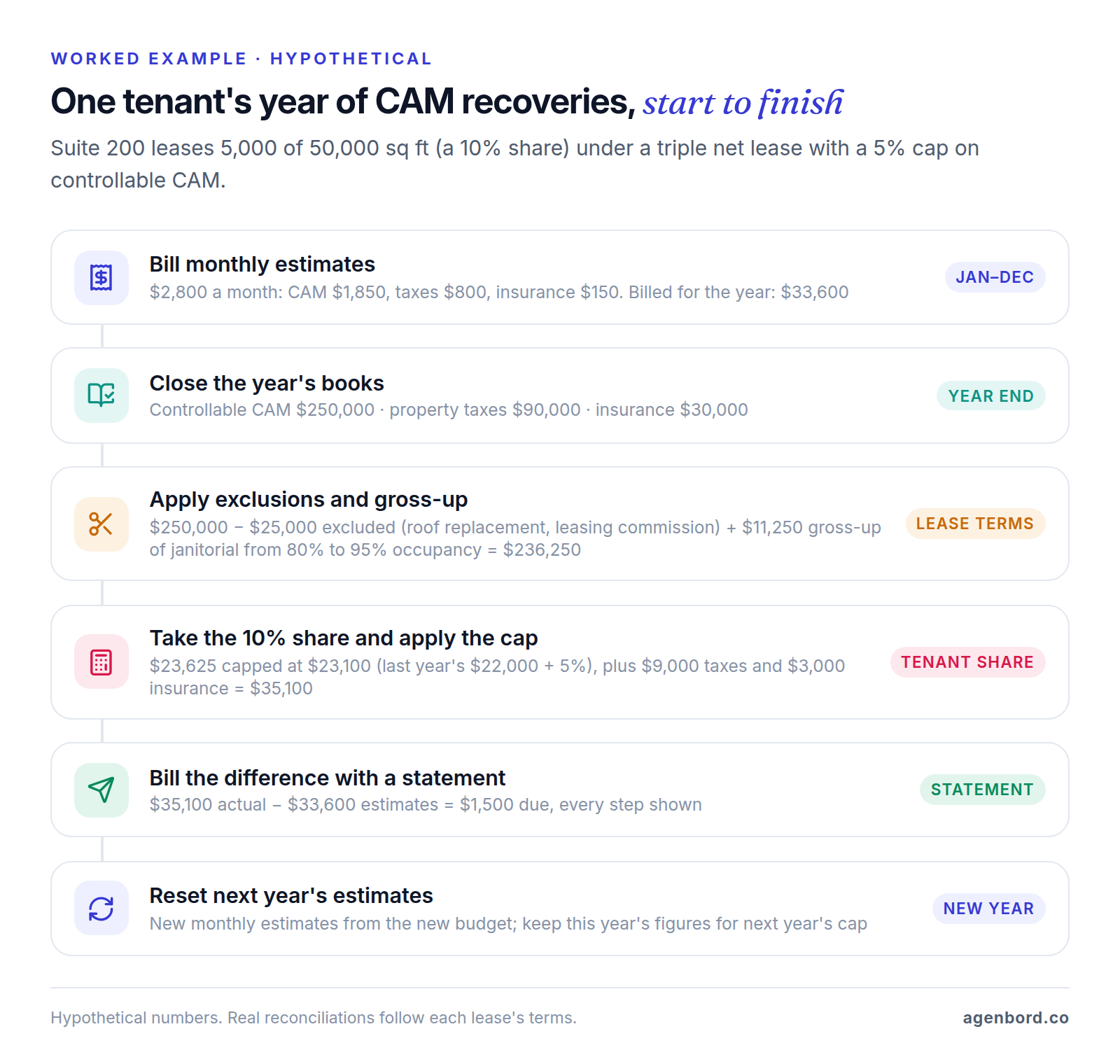
A worked CAM reconciliation (hypothetical)
Take a hypothetical 50,000-square-foot office building with triple net leases. Suite 200 is 5,000 square feet, so its share is 10%. Its lease excludes capital costs and leasing commissions, grosses up janitorial to 95% occupancy and caps the tenant's share of controllable CAM at 5% over the prior year's, non-cumulative. Last year that share was $22,000. This year the building averaged 80% occupancy, and the tenant paid estimates of $2,800 a month: $1,850 for CAM, $800 for taxes and $150 for insurance.
| Step | Calculation | Result |
|---|---|---|
| Controllable CAM booked | General ledger total for the year | $250,000 |
| Less exclusions | Roof replacement $18,000 + leasing commission on another suite $7,000 | −$25,000 |
| Plus gross-up | Janitorial of $60,000 at 80% occupancy, restated at 95%: $60,000 × 95 ÷ 80 = $71,250 | +$11,250 |
| Recoverable controllable CAM | $250,000 − $25,000 + $11,250 | $236,250 |
| Tenant's 10% share | $236,250 × 10% | $23,625 |
| After the 5% cap | $22,000 × 1.05 = $23,100, which is below $23,625, so the cap applies | $23,100 |
| Taxes and insurance (not capped) | 10% of $90,000 taxes + 10% of $30,000 insurance | $12,000 |
| Tenant's actual share | $23,100 + $12,000 | $35,100 |
| Estimates billed | $2,800 × 12 months | $33,600 |
| Balance due from the tenant | $35,100 − $33,600 | $1,500 |
Two details show why this belongs in software rather than a spreadsheet. First, the net $1,500 hides movement both ways. By charge code, CAM ran $900 over its estimates ($23,100 against $22,200 billed), taxes $600 under ($9,000 against $9,600) and insurance $1,200 over ($3,000 against $1,800). Second, the owner absorbs costs too: $525 lost to the cap ($23,625 − $23,100), plus the share of every vacant suite. Good software shows the tenant each step on its statement and shows the owner what wasn't recovered and why.
Percentage rent, tenant billing and deposits
Percentage rent for retail tenants
Many retail leases add percentage rent: a share of the tenant's gross sales above a breakpoint. With a natural breakpoint, that's the annual base rent divided by the percentage. Say a hypothetical restaurant pays $120,000 a year in base rent plus 6% of sales above its natural breakpoint of $2,000,000 ($120,000 ÷ 6%). If annual sales reach $2,300,000, it owes 6% of $300,000, or $18,000.
The software has to collect sales reports on the lease's schedule (a portal upload beats chasing emails), store sales by tenant and period, apply each lease's definition of gross sales and its breakpoint (natural or fixed, prorated for partial years), bill the result and flag late reports. The same data gives you sales per square foot and occupancy cost (rent plus recoveries as a share of sales), early warnings of a tenant in trouble.
Tenant billing and receivables
Each lease generates its own recurring charges: base rent, recovery estimates by charge code, submetered utilities, parking, signage and storage. The system should post them on schedule, apply late fees by each lease's terms and let you set how payments apply. If a tenant disputes a reconciliation and short-pays, you want the payment applied to rent first and the disputed amount flagged as disputed, not aging quietly into a collections problem.
Security deposits and letters of credit
Commercial deposits come in more forms than residential ones. Some are cash, some burn down on a schedule after a run of on-time payments, and many are letters of credit: a bank's promise to pay the landlord on demand, held in place of cash. Track each one's amount, issuing bank, expiry, renewal terms and the date by which you'd have to draw if it isn't renewed. An expired letter of credit is a deposit you no longer hold. Put guaranties on the same list.
Insurance, maintenance, budgets and owner reporting
Tenant insurance certificates
Leases require tenants to carry set coverage, usually naming the landlord (and often the lender and manager) as additional insureds, and to prove it with a certificate of insurance. The software should check each certificate against the lease's requirements, flag shortfalls and request renewals before expiry, and do the same for vendors who work in the building. Ask whether certificate tracking is built in or an add-on.
Work orders and vendors
Requests, preventive maintenance and vendor dispatch work much as they do in residential, with one commercial twist: every work order needs a cost code from the start. Is it billable to the tenant under its lease (a repair inside its suite, after-hours HVAC), a recoverable CAM expense, or a cost the owner absorbs? Coded at the start, the invoice flows to the right place. Coded at year end, it becomes a reconciliation argument.
Budgets and variance
The operating budget is both the owner's plan and the basis for next year's estimates. Keep it in the platform by property and general ledger account, with monthly budget-versus-actual reports, variance comments and reforecasts. A budget in a spreadsheet means estimates typed in by hand, errors included.
Owner reporting and multi-entity accounting
Commercial properties are usually held in separate legal entities, often one LLC per building, each with its own books, bank accounts and lender reporting. The platform needs a general ledger per entity, intercompany entries when one entity pays another's bill, accrual and cash reporting, and consolidated views. A monthly owner package typically combines the income statement and balance sheet, budget variance, rent roll, receivables aging, leasing activity and capital projects.
One category to rule out: if your company is the tenant and needs to account for its own leases under ASC 842, you need lease accounting software built for occupiers. MRI, for example, sells a lease accounting product for ASC 842, IFRS 16 and GASB 87 separately from its property management software.
Commercial property management software compared (October 2026)
Only two of these platforms publish prices. Yardi Breeze lists commercial at $2 per unit per month with a $200 minimum on an annual agreement, with no onboarding, training or support fees. Its pricing page doesn't say how commercial suites count as units, so ask: if each suite counts as one, anything under 100 suites pays the minimum, and 150 suites cost $300 a month. Buildium's plans start at $62, $192 and $400 a month. Everything else is quote-based, so budget for implementation, data migration, lease abstraction, payment fees and add-ons such as tenant portals on top of the subscription.
| Platform | What it is | Price (October 2026) | Ask in the demo |
|---|---|---|---|
| Yardi Breeze | Commercial management and accounting for smaller portfolios | $2/unit/mo, $200 minimum, annual agreement | How suites count as units; the tenant portal is a Premier add-on |
| Yardi Breeze Premier | Breeze plus advanced accounting controls and add-ons | Quote (form on the pricing page) | Which add-ons you need, and their fees |
| Yardi Voyager Commercial | Yardi's larger platform for office, industrial and retail | Quote | Implementation scope, timeline and modules |
| MRI Software | Property Management X plus separate lease, abstraction and investment products | Quote (demo) | Which modules the quote includes |
| Rent Manager | Mixed portfolios, including commercial | Quote (Basic, Plus and Premium bundles) | Caps, gross-up and percentage rent, live |
| AppFolio | Residential-first, with commercial alongside | Quote; Core has a 50-unit minimum and a minimum spend | Caps, gross-up, percentage rent and the API tier |
| Buildium | Residential-first, with CAM and NNN charge tracking | From $62/mo (Essential) to $400/mo (Premium) | Which plan includes CAM reconciliation |
| VTS | Leasing and asset management, not accounting | Quote | How it syncs with your accounting system |
The notes behind the table:
- Yardi Breeze lists NNN, gross or combination leases, custom expense pools with caps and percentage allocations, estimated charges reconciled monthly, quarterly or annually, rent escalations, retail sales tracking and percentage rent. That's the commercial core at a published entry price, which makes it the natural first look for a few buildings. Breeze Premier adds advanced accounting controls, customizable owner financials, portfolio comparisons and add-ons such as the CommercialCafe tenant portal.
- Yardi Voyager Commercial keeps lease terms for office, industrial and retail property in one place, with accounting Yardi says meets GAAP and IFRS requirements, plus role-based dashboards and workflows. Breeze's own site points customers who need more to Voyager.
- MRI Software: Property Management X covers residential, office, industrial, retail and mixed-use property, and MRI describes combining property management and accounting "to streamline rent, recoveries, and reporting," with a configurable general ledger and multi-entity reporting. Lease management, lease abstraction, investment management and a tenant portal are separate products, so compare quotes module by module.
- Rent Manager lists CAM reconciliation that compares recoverable expenses with tenant charges and sets each tenant's pro-rata share, plus commercial lease management, budgeting and forecasting, commercial rent roll and retail sales reports, user-defined fields and an API. It suits mixed portfolios; confirm caps and percentage rent in the demo.
- AppFolio runs commercial properties alongside other property types and lists CAM tracking and reconciliation. It suits managers whose portfolio is mostly residential.
- Buildium lists CAM charges, tracking and reconciliation, triple net charges, scheduled rent increases and insurance certificate tracking on its commercial page, without saying which plan includes them.
- VTS covers leasing and asset management. VTS Lease handles deal tracking, approvals, cash flow analysis and proposals, and VTS says it integrates with most major property management accounting systems, including Yardi and MRI. It sits beside your accounting platform rather than replacing it.
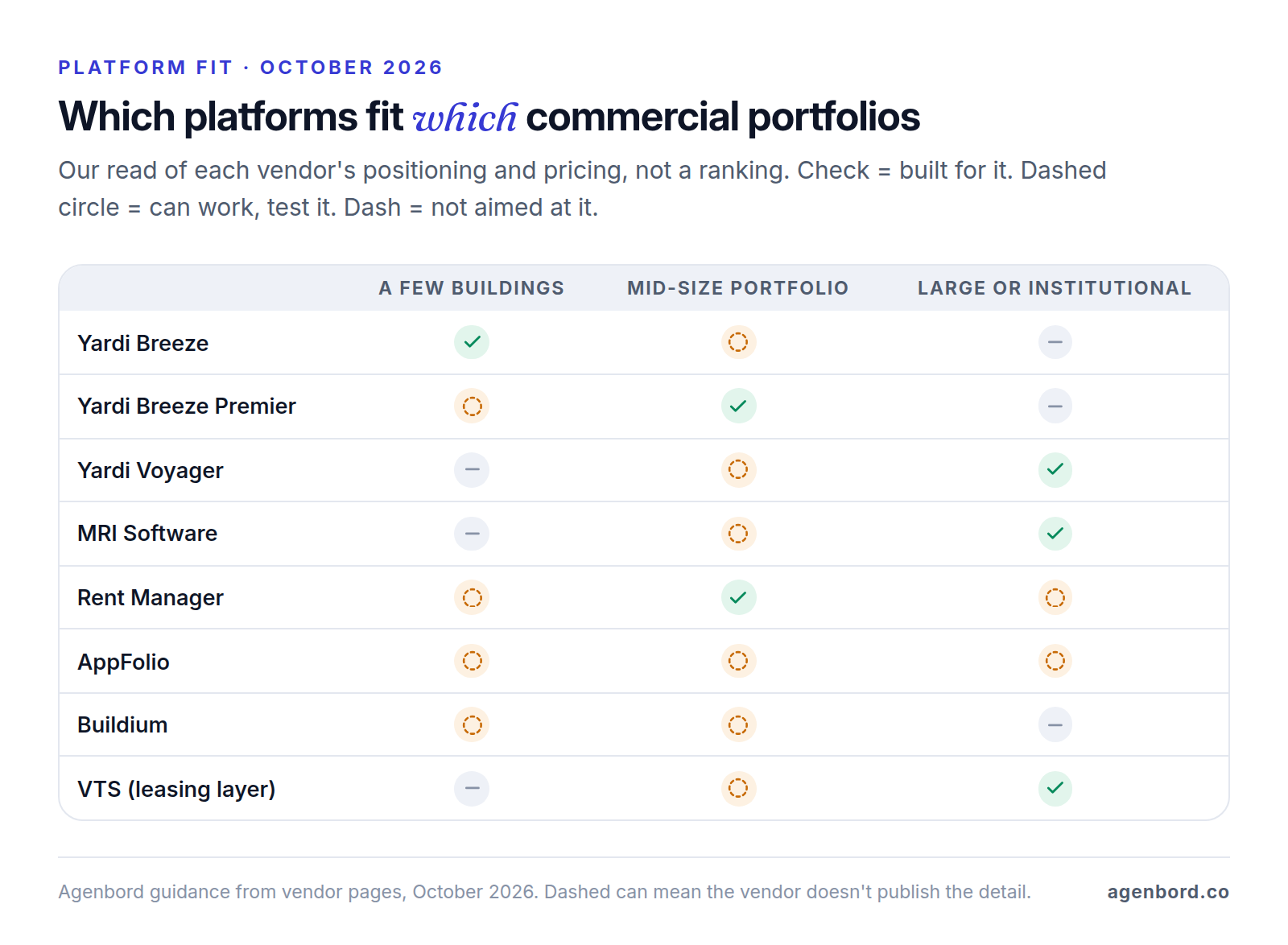
So which is the best commercial property management software? The one that runs your actual leases, caps, base years and percentage rent included, with no spreadsheet beside it, at a cost that still works in year three. If you also own residential units, add Buildium or AppFolio to a small-portfolio shortlist; at the large end, add VTS only if your leasing volume justifies a dedicated leasing platform.
How to choose: checklist and demo script
Judge the shortlist against your own leases, not the vendor's feature list. Before any demo, confirm each platform handles:
- Every lease structure you have (gross, base-year and NNN), mixed within one building
- Recovery pools with per-lease shares and denominators, caps (cumulative or not), exclusions, gross-up and admin fees
- Retail sales reporting and percentage rent with natural and fixed breakpoints
- Rent schedules, options, critical dates, letters of credit and insurance certificates, with alerts
- Work orders coded as tenant-billable, recoverable or owner cost, and budgets that drive estimates
- A general ledger per entity, intercompany entries, consolidation and an owner package you'd actually send
- A full data export, the API tier you'd need, and three-year total cost at your expected size
Then give every finalist the same script and ask them to run it live in a sandbox, not in slides:
- Set up the lease. Use Suite 200 from the example: 5,000 of 50,000 square feet, NNN, 3% annual rent steps, a renewal option with a notice date and a letter of credit with an expiry date.
- Configure recoveries. Controllable CAM with a 5% non-cumulative cap, exclusions for capital costs and leasing commissions, janitorial grossed up to 95%, and taxes and insurance uncapped.
- Bill a year of estimates by charge code: $1,850 for CAM, $800 for taxes and $150 for insurance each month.
- Post the year's actual costs, including the roof replacement and the leasing commission, and run the reconciliation. The answer is $1,500 due. Ask to see the tenant's statement.
- Record a short payment of $1,000 against it, and show how the payment applies and how the remaining $500 ages.
- Produce the owner report: income statement, budget variance, rent roll, receivables aging and a recovery report showing what the cap and vacancy cost the owner.
- Export everything, including leases, charges and the reconciliation workpapers, to a spreadsheet.
A vendor that reaches $1,500 with a clean tenant statement has shown you more than any feature grid. One that needs a week and a consultant to set it up has told you something too. Score the results with the weighted scorecard in our overview, shifting weight toward recoveries and owner reporting.
Switching platforms: abstracts, opening balances and recoveries in progress
Commercial migrations go wrong in the recoveries, not the rent roll. Whichever online commercial property management software you move to, plan for these:
- Abstract or re-verify every lease to the standard above, amendments included, before any data moves.
- Cut over at a month end, ideally after last year's reconciliations are billed, so no recovery year is split across two systems.
- Bring opening balances by tenant and charge code, not as one lump: receivables, prepaid rent, deposits and letters of credit held, owner balances, open bills and a trial balance for each entity.
- Carry recoveries in progress. A mid-year cutover needs year-to-date estimates billed per tenant and charge code, year-to-date expenses per pool, the prior-year figures caps are measured against (like Suite 200's $22,000) and every base-year amount.
- Test with last year. Rerun last year's reconciliation in the new system and compare it with what you billed. Differences point to abstraction or setup errors.
- Tell tenants early: new remittance details, portal logins and who to call about the first statements.
When a custom tenant or owner portal pays off
Most commercial owners should buy. Recoveries, multi-entity accounting and owner reporting are mature in the platforms above, and rebuilding them yourself adds risk without adding value. Our build-vs-buy framework covers the general decision. Custom work pays off in three situations, and in each it sits on top of your platform rather than replacing it:
- An investor portal across entities and systems. Investors who want property-level dashboards, distributions and documents for several entities in one login, while your data lives in an accounting platform, a leasing tool and spreadsheets. A custom web portal pulls from each and presents it your way. Our guide to client portal software covers the security rules any portal has to follow.
- Tenant workflows your platform doesn't offer. Certificate uploads checked against each lease's requirements, monthly sales reports for percentage rent, after-hours HVAC requests that bill the tenant automatically, or move-in checklists for multi-floor tenants.
- An integration layer. Syncing a leasing pipeline with accounting, feeding submeter readings into utility chargebacks, loading budgets from your underwriting model, or building one reporting database across platforms. Our CRM integration guide explains the patterns, from field ownership to API limits.
Check API access before scoping anything. AppFolio's API, for example, is read-only on Plus and read/write on Max, and a tier upgrade can cost less than custom code.
For budgeting, our typical ranges are a single workflow automation, such as certificate expiry reminders, from $1,500; an internal tool or dashboard from $12,000; and a tenant or investor portal at $25,000–$60,000 over 8–14 weeks. Add hosting of roughly $50–$500 a month and maintenance of about 15–20% of the build cost per year. We price custom software as a fixed-price proposal with a written scope and weekly demos, and you own the code. Our real estate and property management page shows the owner and tenant portals we build.
If none of those three situations applies, put the money into the right platform tier and a careful lease abstraction instead.
Sources
- Yardi Breeze - Pricing (accessed October 2026)
- Yardi Breeze - Commercial property management software (accessed October 2026)
- Yardi Breeze - Home page (accessed October 2026)
- Yardi - Voyager Commercial (accessed October 2026)
- MRI Software - Commercial real estate software (accessed October 2026)
- MRI Software - Property Management X (accessed October 2026)
- MRI Software - Lease accounting software (accessed October 2026)
- Rent Manager - Commercial property management (accessed October 2026)
- Rent Manager - Pricing (accessed October 2026)
- AppFolio - Commercial property management software (accessed October 2026)
- AppFolio - Pricing (accessed October 2026)
- Buildium - Commercial property management (accessed October 2026)
- Buildium - Pricing (accessed October 2026)
- VTS - Home page (accessed October 2026)
- VTS - VTS Lease (accessed October 2026)
Prices, plans and regulations change. Figures were checked on October 2, 2026; follow the links for the latest. Nothing here is legal, tax or financial advice.
About the author
Founder, Agenbord
Muhammad Hamza is the founder of Agenbord, the Fort Lauderdale software company behind the construction ERP Smart Construction and a WhatsApp-first billing platform. He writes practical guides on buying, building and automating business software.