On this page
- What does property management software do?
- How needs differ: small landlords, managers, commercial and HOAs
- How much does property management software cost?
- Property management software compared (October 2026)
- How to choose property management software
- Switching platforms: migration and onboarding tips
- When a custom portal or integration makes sense
Property management software is the system landlords and property managers use to run the rental cycle in one place: market a vacancy, screen applicants, sign the lease, collect rent online, handle repairs, keep the books and send owners their statements. A landlord with a few doors can do most of that on a free or $12-a-month app. A management company holding other people's money needs trust accounting, owner portals and vendor workflows, and usually pays per unit for them.
As of October 2026, published entry plans run from $0 to about $400 a month, and the platforms bigger managers use mostly quote on request. The pricing model matters more than the sticker price, and the accounting module matters more than either. We build custom software, so we'll also say when a custom portal or integration is worth paying for. For most readers, it isn't.
What does property management software do?
Underneath, it's a database of properties, units, people, leases and money, with workflows on top. These are the modules that matter, and the question each one should survive in a demo.
Listings and vacancy marketing
You write the listing once, with photos and rent, and the software publishes it to your website and to listing sites, then collects inquiries and showing requests in one place. Ask which sites it actually syndicates to, whether every lead lands in one inbox with the unit attached, and whether you can see days vacant by unit.
Applications and tenant screening
Online applications collect the applicant's details and fee, then order credit, criminal and eviction reports through a screening partner. Those reports are consumer reports under the Fair Credit Reporting Act. The FTC's guidance for landlords says that if you deny an application, require a co-signer or a bigger deposit, or charge more rent because of a report, you owe the applicant an adverse action notice that names the reporting company and explains their right to dispute. Good software generates that notice for you.
Screening fees are regulated in some states, too. New York, for example, caps background and credit check fees at the actual cost or $20, whichever is less.
Leases and e-signature
Lease templates, addenda, e-signatures, renewals and move-in and move-out workflows. Check whether templates are state-specific (Yardi Breeze Premier, for instance, lists state-based lease documents and addenda) and what signing costs: Buildium charges $5 per document on its Essential plan, $1 on Growth and nothing extra on Premium.
Online rent collection and payments
Tenants pay by bank transfer (ACH) or card, set up autopay and get reminders, and late fees post automatically under your lease terms. The details decide whether it works for you: who pays each fee, how fast money reaches your account, whether you can switch off card payments, and whether security deposits can go to a different bank account than rent.
Accounting and trust accounting
This is the module that separates landlord apps from manager platforms, and the one to test hardest. Every platform tracks income and expenses by property. If you manage for other owners, you also need trust accounting: their rent, reserves and (in many states) tenants' security deposits sit in a trust account kept apart from your operating money, every dollar in it belongs to a specific owner or tenant, and one owner's bills are never paid with another owner's money.
Regulators take this seriously. California's Department of Real Estate requires brokers to reconcile the total of their separate records for each owner or tenant against the trust account's control record at least once a month, and seven of the ten violations on its list of the most common audit findings involve trust funds, including shortages, missed reconciliations and commingling. Deposit rules reach self-managing landlords as well: in Florida, a landlord must hold deposits in a separate account at a Florida financial institution or post a surety bond, and tell the tenant how, in the lease or within 30 days (section 83.49). Rules vary by state, so treat this as general information and confirm yours with your state's real estate regulator and your CPA.
In a demo, ask the vendor to close a month. They should show a three-way reconciliation (bank balance, trust account register and the sum of owner and tenant ledgers all agreeing), then try to pay a bill larger than an owner's balance so you can see whether the system stops it.
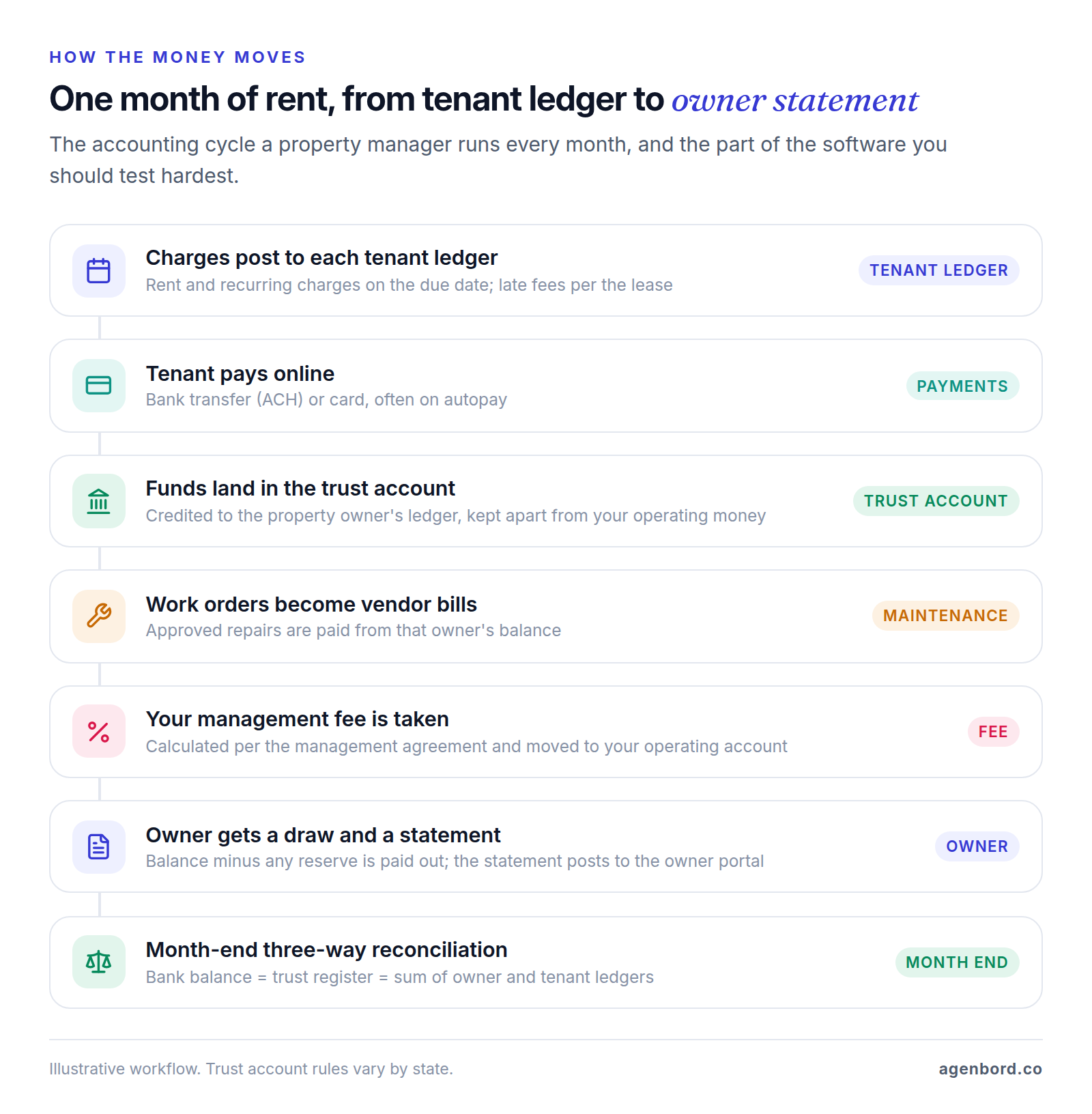
Maintenance requests and vendor work orders
Tenants submit requests with photos. You triage, assign a vendor, set a not-to-exceed amount and track the job to completion, and the finished work order should become a bill charged to the right owner without retyping. Check the vendor's side (a portal or app for updates and invoices), per-owner approval limits, and whether recurring work like filter changes can be scheduled.
Owner portals and statements
Owners log in to see statements, payouts, documents and open work orders, and to approve larger repairs. Year end matters here too: the IRS instructions for Form 1099-MISC put the duty to report rent paid over to property owners on the property manager, not the tenant. Check that the software prepares and e-files owner and vendor 1099s, and what that costs. Buildium, for example, charges $50 per batch plus $4.50 per form.
Tenant portals and communication
Tenants pay, check their ledger, submit requests, sign documents and get notices from one login or app. Bulk email and text for notices like a water shutoff is worth having, as long as every message is logged against the unit so you can show what was sent and when.
Inspections
Move-in, move-out and periodic inspections with photos and notes, so the move-out report can be compared with the move-in one when you settle the deposit. Some vendors include this only on higher tiers: Buildium's Essential plan needs an add-on ($99 setup plus $40–$95 a month), and Rent Manager lists video inspections in its Premium bundle.
Reporting
Rent roll, delinquency, vacancy, owner statements, profit and loss by property, and budget versus actual are the baseline. Two things matter more than the report list: whether you can build your own reports, and whether you can export all of your data, including transaction history. You'll need that export if you ever switch.
How needs differ: small landlords, managers, commercial and HOAs
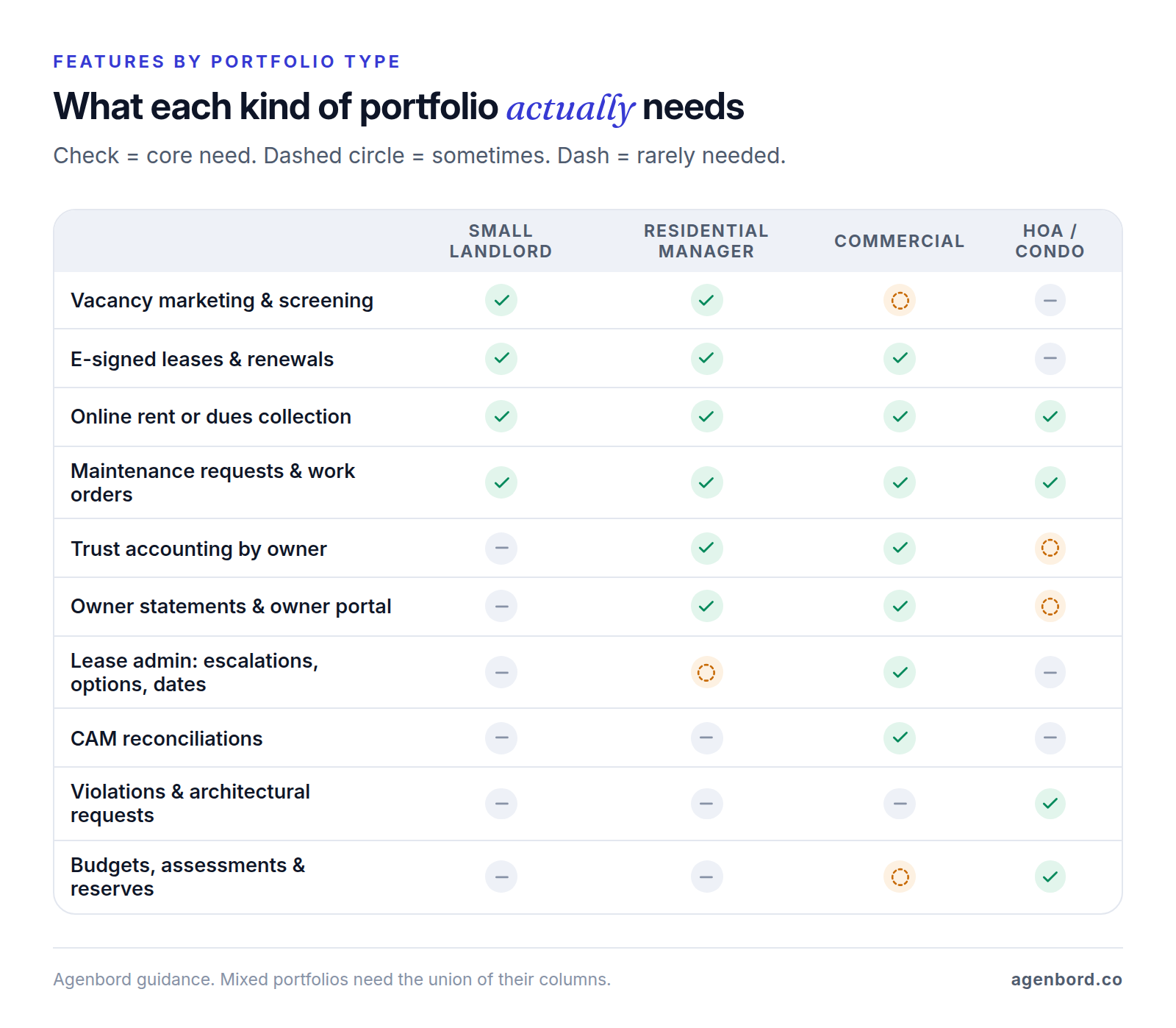
"Property management" covers very different businesses. The matrix shows where their needs split; the notes below explain why.
Property management software for small landlords
If you own and manage your units yourself, the essentials are screening, e-signed leases, online rent with autopay, maintenance requests and expense tracking by property. That last one pays off at tax time: individual landlords generally report rental income and expenses on Schedule E, so expense categories that map to it turn tax prep into an export instead of a project. You don't need trust accounting by owner because the money is yours, though deposit rules like Florida's may still apply. Free and flat-price tools are built for this.
Residential property management companies
Once you manage for other owners, the platform becomes your accounting system of record. You need trust accounting, owner statements and portals, management fees calculated from each agreement, vendor management, 1099s, multiple bank accounts and user permissions. Affordable and student housing add their own compliance and leasing rules: AppFolio puts those capabilities in its Plus plan, and Yardi Breeze prices affordable housing on Breeze Premier at $3 per unit per month with a $400 monthly minimum.
Commercial property management software
Commercial leases are long, negotiated and full of clauses that move money, so commercial software is mostly lease administration and expense recovery. Lease administration tracks rent steps, renewal and expansion options, critical dates and, for retail, percentage rent based on tenant sales. CAM (common area maintenance) reconciliation is the annual true-up: tenants pay estimated monthly charges for shared costs, often along with taxes and insurance under triple net (NNN) leases, and after year end you compare actual expenses with the estimates and bill or credit each tenant its pro-rata share, applying the caps and exclusions in each lease.
Check how a platform models expense pools and caps. Yardi Breeze, for example, lists NNN and gross leases, custom expense pools, caps, estimated charges with reconciliation, escalations and percentage rent, and its commercial Breeze plan costs $2 per unit per month with a $200 minimum. MRI Software sells lease management, lease abstraction and lease accounting as separate products. And if you're a business tracking leases you sign as a tenant, you want lease accounting software, a different category. Our commercial property management software guide goes deeper, with a worked CAM reconciliation and a demo script.
HOAs and community associations
Associations aren't landlords, and they usually run on HOA management software instead: assessments, budgets and reserves, violations, architectural requests, board approvals, owner directories, meeting notices and document libraries. Some property management platforms sell association editions. Yardi Breeze Premier lists associations at $1 per unit per month with a $400 minimum, Buildium quotes association pricing by phone, and Rent Manager and MRI list associations among the portfolios they serve. Many Florida associations must also post official records online: see our guide to Florida HOA and condo website requirements for the thresholds, and our page on HOA and condo association portals for what we build.
How much does property management software cost?
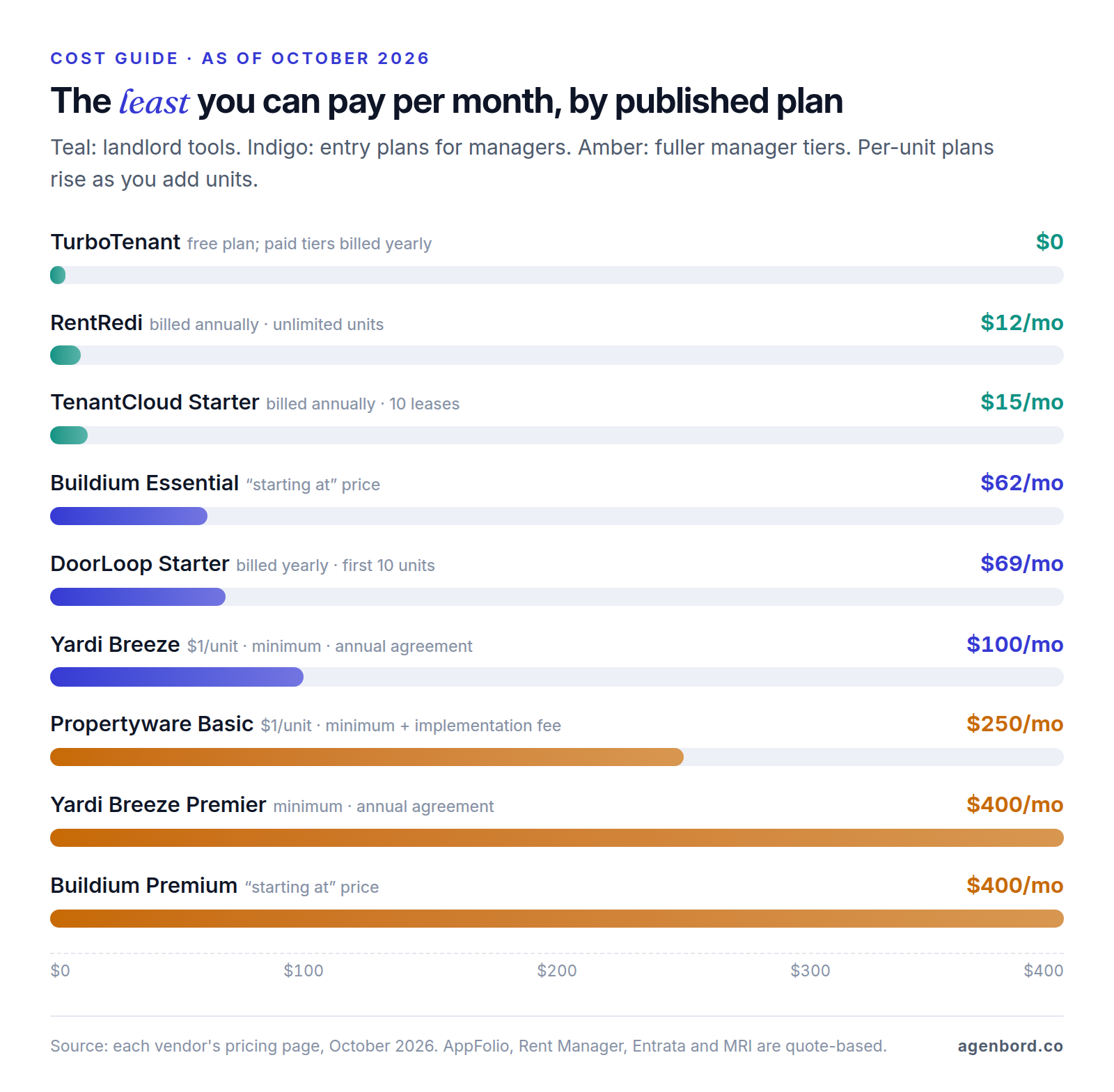
Published entry prices start at $0 for landlord plans and reach about $400 a month for fuller manager tiers, while AppFolio, Rent Manager, Entrata and MRI quote on request. What you actually pay depends on three things: the pricing model, your unit count and the fees around the subscription.
Per unit per month, with minimums
Platforms built for managers mostly charge per unit with a monthly floor. Yardi Breeze charges $1 per residential unit per month with a $100 minimum on an annual agreement, and says there are no onboarding, training or support fees. Propertyware charges $1.00, $1.50 or $2.00 per unit with minimums of $250, $350 or $450, bills units in 50-unit increments, and adds an implementation fee of twice the monthly subscription. AppFolio doesn't publish prices; its Core plan comes with a 50-unit minimum and a minimum spend.
Minimums dominate for smaller portfolios. A hypothetical 150-unit manager would pay $150 a month on Yardi Breeze, but $250 a month on Propertyware Basic (150 units at $1 is below the minimum), plus a $500 implementation fee.
Flat or tiered subscriptions
- Buildium: Essential starts at $62 a month, Growth at $192 and Premium at $400; the two upper plans require Buildium's onboarding service, which isn't priced on the page.
- DoorLoop: Starter is $69 a month billed yearly ($99 month to month) and covers up to 10 units. Pro and Premium list at $149 and $209 a month billed yearly and rise with unit count.
- TenantCloud: priced by lease count, at $15, $29.17 or $50 a month billed annually for 10, 30 or 60 leases. There's no free plan.
- RentRedi: one plan with unlimited units, at $12 a month billed annually or $29.95 month to month.
Free property management software, and who really pays
Free plans move the cost to applicants and tenants. TurboTenant's Free plan lets you list, screen and collect rent for $0; applicants pay the screening fee ($45 on the Free plan, $55 on Pro) and renters pay 3.49% on card payments. Its paid Essentials and Pro plans cost $149 and $199 a year for 1–10 units, rising to $349 and $999 a year at 61 units and up.
Two other free options start from bookkeeping and banking. Stessa's free Essentials plan centers on bookkeeping, with bank feeds, basic reports and rent collection. Baselane's free Core plan pairs banking (provided by Thread Bank, Member FDIC; Baselane itself isn't a bank) with bookkeeping and rent collection. For many small landlords that's a fair trade, as long as you check your state's limits on what applicants can be charged.
Onboarding, add-on and payment fees
This is where budgets slip:
- Onboarding and implementation: none at Yardi Breeze, required on Buildium's Growth and Premium plans, and a fixed multiple of the subscription at Propertyware.
- Payments: Buildium charges per incoming bank transfer by plan ($2.35 on Essential, $1.35 on Growth, and on Premium free for 12 months, then $0.60), plus $0.99 per outgoing transfer and 2.99% on cards. At DoorLoop, tenants pay 3.25% on cards and $2.49 per ACH payment on Starter (about $1 on Pro, free on Premium).
- Extras: bank accounts (Buildium charges $99 per business bank account beyond those included in your plan), e-signatures, screening, 1099 e-filing, inspections, websites, and API access, which often sits on the top tier.
Price the full stack at the unit count you expect in three years, not today's.
Property management software compared (October 2026)
Prices are list prices from each vendor's pricing page as of October 2026. "Best fit" is our read of who each platform is built for.
| Platform | Best fit | Published price | Watch for |
|---|---|---|---|
| TurboTenant | Self-managing landlords | Free plan; Essentials $149/yr, Pro $199/yr (1–10 units) | Applicants and renters pay screening and card fees |
| RentRedi | Landlords who want one flat price | $12/mo billed annually; $29.95 month to month | Screening is tenant-paid, from $39.99 |
| TenantCloud | Landlords and small managers | $15/mo billed annually (10 leases) to $50/mo (60 leases) | No free plan; owner portal on Pro and Business only |
| DoorLoop | Growing landlords and managers | From $69/mo billed yearly (first 10 units) | Price rises with units; demo above 300 units |
| Buildium | Residential managers and associations | Essential from $62/mo; Premium from $400/mo | Required onboarding on Growth and Premium; per-payment fees |
| Yardi Breeze | Residential, commercial, affordable and association portfolios | $1/unit/mo, $100 minimum (residential); $2/unit/mo, $200 minimum (commercial) | Annual agreement; Premier tiers carry a $400 minimum |
| Propertyware | Single-family rental managers | $1.00–$2.00/unit/mo with $250–$450 minimums | Implementation fee of twice the monthly price |
| AppFolio | Mid-size and large residential managers | Quote-based | 50-unit minimum and minimum spend on Core |
| Rent Manager | Mixed portfolios, including commercial and self storage | Quote-based | Get the full fee schedule in writing |
| Entrata | Multifamily operators, including student, affordable and military housing | Quote-based | Demo and quote required |
| MRI Software | Enterprise residential and commercial portfolios | Quote-based | Lease management and lease accounting are separate products |
So what is the best property management software? The one whose accounting and workflows fit your portfolio at a total cost you can live with in year three. A 6-unit landlord and a 600-unit manager should never be comparing the same shortlist.
How to choose property management software
Start with portfolio size and property type, then score the shortlist.
- Units you own and manage yourself: a free or flat-price landlord tool. Prioritize screening, e-signed leases, autopay and expense categories.
- Your first third-party doors: move to a platform built for managers before you take on owners' money, because changing accounting systems mid-year is painful. Buildium, DoorLoop and Yardi Breeze publish entry prices of $62–$100 a month.
- 50–300 units: per-unit platforms come into their own, and AppFolio's 50-unit minimum puts it in range. If your portfolio is all single-family homes, a specialist like Propertyware is worth a look.
- 300+ units or several property types: expect quote-based pricing (AppFolio, Rent Manager, Entrata, MRI), a formal implementation and a contract worth negotiating.
- Commercial or associations: start from the segment's must-haves above (lease administration and CAM, or association management) and compare prices only after that.
Then run the same scripted demo with every finalist and score it. Adjust the weights to your business; commercial managers, for example, should add CAM and lease administration.
| Criterion | Weight (example) | What the vendor should show you |
|---|---|---|
| Accounting and trust | 25% | A month-end close with a three-way reconciliation, and a bill that exceeds an owner's balance |
| Owner experience | 15% | A real owner statement, the owner portal, a payout and a 1099 |
| Payments | 15% | Fees per ACH and card payment, who pays them, and how fast money arrives |
| Maintenance and vendors | 15% | A request with photos becoming a work order, a vendor bill and an owner charge |
| Leasing and screening | 10% | Listing to signed lease, including an adverse action notice |
| Data and integrations | 10% | A full data export, which tier includes the API, and bank and accounting connections |
| Three-year total cost | 10% | Subscription, onboarding, payment fees and add-ons at your projected unit count |
Score each criterion from 1 to 5, multiply by the weight and add it up. If two platforms land within a few points, choose the one your bookkeeper and your busiest manager prefer after using the trial.
Switching platforms: migration and onboarding tips
Most migrations go wrong on balances, not features. Work through this list:
- Cut over at a month end, after you've reconciled the old system one last time.
- Move opening balances, not years of history: tenant balances, deposits held, prepaid rent, owner balances and reserves, and open bills. Export the full history and keep it.
- Clean up first: duplicate tenants, vendors missing tax forms, and units that don't match their leases.
- Re-create recurring charges and lease terms, including rent steps and end dates, then spot-check a sample against the signed leases.
- Set up payment accounts early, because online payments need their own setup and approval before tenants can pay.
- Tell tenants and owners a few weeks ahead: new logins, and tenants should expect to re-enter payment details and autopay.
- Run one close in both systems and compare owner statements line by line before you switch the old one off.
When a custom portal or integration makes sense
Most landlords and property managers should buy, not build. The platforms above cover the standard workflow well, and rebuilding trust accounting yourself adds risk with no upside. Our build-vs-buy framework walks through the general decision. For property management, custom work pays off in three situations, and in each one it sits on top of your platform rather than replacing it:
- Owner and investor portals beyond standard statements. Investor groups that want property-level dashboards, distribution history and documents across several entities in one login. A custom web portal pulls the data from your platform and presents it your way.
- Workflows your platform doesn't model. Unit turns run by in-house crews, vendor compliance tracking, or a leasing pipeline that needs more than the platform offers, where a focused CRM can sit alongside it. If you also run a brokerage, our real estate CRM guide covers the sales side.
- Data spread across systems. A company running residential on one platform, commercial on another and associations on a third that wants one set of KPIs and one owner login.
Before scoping anything, check API access, because it varies by tier. AppFolio's API is read-only on Plus and read/write on Max, Buildium's open API comes with Premium only, and Propertyware adds $1 per unit per month for Enterprise/API access. Sometimes the tier upgrade is the cheapest "custom" option.
For budgeting, our typical ranges are a single workflow automation from $1,500, an internal dashboard or tool from $12,000, and an owner or customer portal at $25,000–$60,000 over 8–14 weeks. Add hosting of roughly $50–$500 a month and maintenance of about 15–20% of the build cost per year. We price custom software as a fixed-price proposal with a written scope, and you own the code. Our real estate and property management page shows the portals and integrations we build for the industry.
If none of those three situations applies to you, put the money into the right platform tier and a clean migration instead.
Sources
- Buildium - Pricing (accessed October 2026)
- Yardi Breeze - Pricing (accessed October 2026)
- Yardi Breeze - Commercial property management software (accessed October 2026)
- AppFolio - Pricing (accessed October 2026)
- DoorLoop - Pricing (accessed October 2026)
- TenantCloud - Pricing (accessed October 2026)
- TurboTenant - Pricing (accessed October 2026)
- RentRedi - Pricing (accessed October 2026)
- Propertyware - Pricing (accessed October 2026)
- Propertyware - Single-family rental property management software (accessed October 2026)
- Rent Manager - Pricing (accessed October 2026)
- Entrata - Home page (accessed October 2026)
- MRI Software - Home page (accessed October 2026)
- Stessa - Pricing (accessed October 2026)
- Baselane - Pricing (accessed October 2026)
- Federal Trade Commission - Using Consumer Reports: What Landlords Need to Know (accessed October 2026)
- New York State Senate - Real Property Law Section 238-A, Limitation on fees (accessed October 2026)
- Florida Legislature - Section 83.49, Florida Statutes: Deposit money or advance rent (accessed October 2026)
- California Department of Real Estate - Ten Most Common Violations Found in DRE Audits (accessed October 2026)
- IRS - Instructions for Forms 1099-MISC and 1099-NEC (accessed October 2026)
- IRS - About Schedule E (Form 1040), Supplemental Income and Loss (accessed October 2026)
Prices, plans and regulations change. Figures were checked on October 1, 2026; follow the links for the latest. Nothing here is legal, tax or financial advice.
About the author
Founder, Agenbord
Muhammad Hamza is the founder of Agenbord, the Fort Lauderdale software company behind the construction ERP Smart Construction and a WhatsApp-first billing platform. He writes practical guides on buying, building and automating business software.