On this page
- What is software development outsourcing?
- Onshore vs nearshore vs offshore: what actually changes
- Is outsourcing cheaper than hiring in-house?
- Engagement types: fixed price, time and materials, dedicated team or retainer
- Software development outsourcing contract checklist
- Red flags and questions to ask when outsourcing software development
- How to run a paid pilot or discovery phase
- How to manage an outsourced development team week to week
You have software to build and no development team, or a team that's already busy. Software development outsourcing means paying an outside company to design, build or maintain that software under a contract.
The first question is usually where the team should be: onshore in the US, nearshore in Latin America, or offshore in Europe or Asia. Location changes how many working hours you share, how easily you can enforce the contract and the hourly rate. It doesn't decide whether the project works. That comes down to a precise written scope, a contract that gives you the code, and working software you can click through every week.
We build custom software, so we're one of the companies you might hire. Hold us to the same checklist.
What is software development outsourcing?
Software development outsourcing is contracting with another company to deliver software, or part of the work on it. The vendor finds, employs and manages the people; you pay for the result or for the time, as the contract says. In custom software development outsourcing, an outside team builds a whole application, such as a customer portal, an operations system or an MVP. You can also outsource narrower work: testing, maintenance or one feature.
What separates it from the other ways of getting software built is who directs the work and who carries the risk when it runs late:
| Option | Who directs the work | Who carries the risk of late or broken work | Usual way to pay | Fits when |
|---|---|---|---|---|
| In-house team | You | You | Salaries and benefits | Software is your product and the roadmap never ends |
| Staff augmentation | You; the vendor supplies developers | You | Hourly or monthly, per person | You have a technical lead and need more hands |
| Freelancer | You | Mostly you | Hourly or per task | A small, well-defined job, with someone technical to check it |
| Agency or dev shop | The vendor, against your written scope | The vendor on a fixed price; you on time and materials | Fixed price per phase, or time and materials | You need a defined result: an MVP, a portal, an internal tool |
| Dedicated team | Shared: the vendor manages people, you set priorities | Mostly you | A monthly fee | Long-running product work without hiring |
Staff augmentation is easy to mistake for outsourcing. But if you assign the developers' tasks and review their work, the delivery risk is yours, whoever employs them.
Two decisions come first. Our build-vs-buy framework helps you settle whether to build at all. And if the problem is mostly moving data between tools you already pay for, business process automation software may fix it without a custom build.
Onshore vs nearshore vs offshore: what actually changes
- Onshore: a team in your own country. For a US business that's a US team, possibly three time zones away.
- Nearshore: a nearby country with similar working hours. For US companies, nearshore software development outsourcing usually means Latin America, and sometimes Canada.
- Offshore: a distant country with a big time difference, such as Poland or Romania in Central and Eastern Europe, or India, the Philippines or Vietnam in Asia.
Many vendors mix these, such as a US company with developers abroad. So ask every vendor where the people on your project will work, and which legal entity signs your contract.
Time-zone overlap
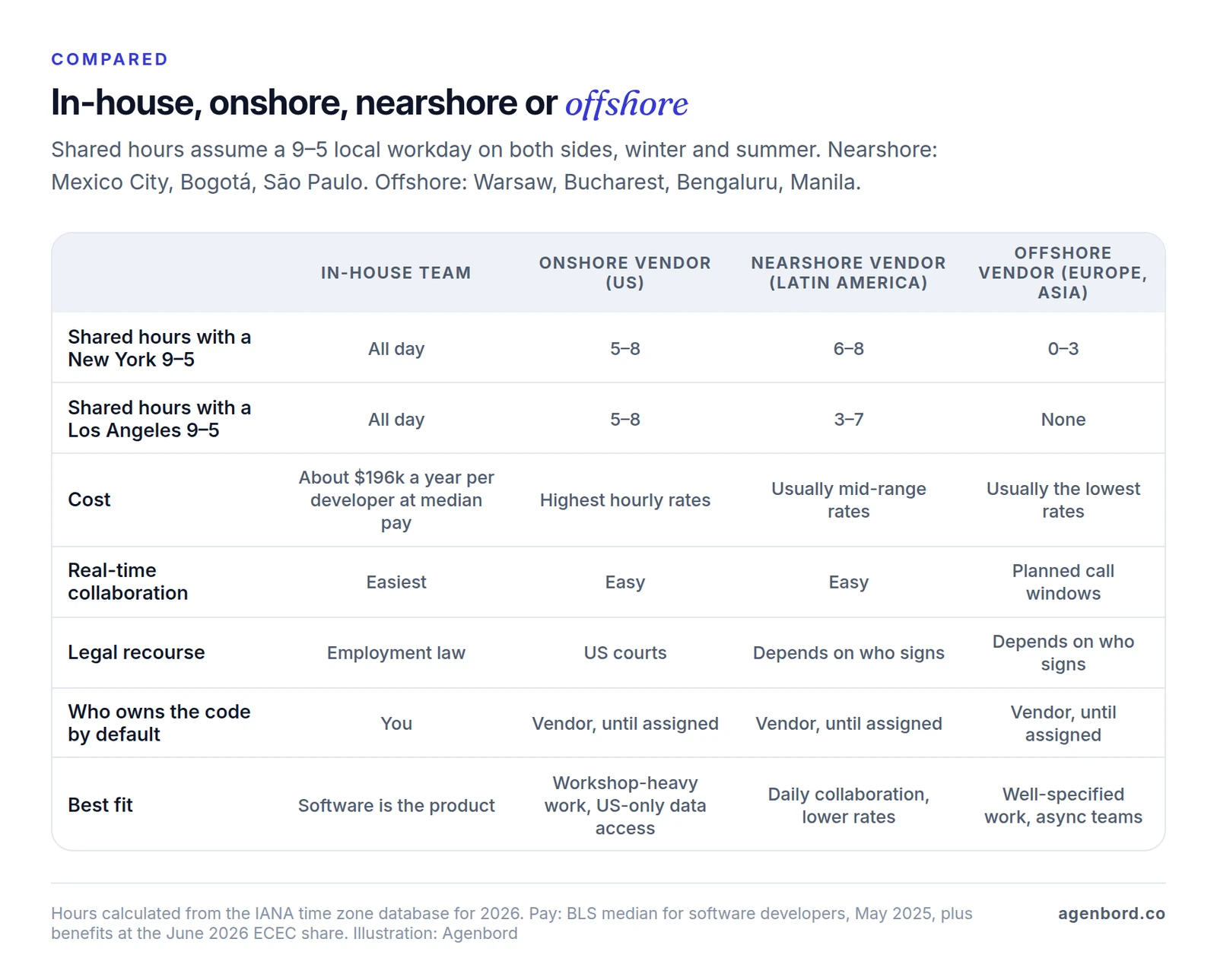
Overlap is the part of the day when both teams are working, so a question gets answered in minutes instead of overnight. This is how a 9 a.m. to 5 p.m. local workday lines up in 2026, calculated from the IANA time zone database:
| Where the team works | Hours ahead of (+) or behind (–) New York | Shared hours with a 9–5 day in New York | Shared hours with a 9–5 day in Los Angeles |
|---|---|---|---|
| US Eastern time | 0 | 8 | 5 |
| US Pacific time | –3 | 5 | 8 |
| Mexico City | –1 in winter, –2 in summer | 7 in winter, 6 in summer | 6 in winter, 7 in summer |
| Bogotá | 0 in winter, –1 in summer | 8 in winter, 7 in summer | 5 in winter, 6 in summer |
| São Paulo | +2 in winter, +1 in summer | 6 in winter, 7 in summer | 3 in winter, 4 in summer |
| Warsaw | +6 (+5 for about four weeks a year) | 2 (3) | 0 |
| Bucharest | +7 (+6 for about four weeks a year) | 1 (2) | 0 |
| Bengaluru | +10.5 in winter, +9.5 in summer | 0 | 0 |
| Manila | +13 in winter, +12 in summer | 0 | 0 |
"Summer" means US daylight saving time, from the second Sunday in March to the first Sunday in November. Mexico City, Bogotá, São Paulo, Bengaluru and Manila don't change their clocks, so their gap with the US shifts twice a year. The EU changes clocks on the last Sundays of March and October, so for about four weeks a year (in 2026, March 8–28 and October 25–31) Warsaw and Bucharest are an hour closer than usual.
Zero overlap doesn't make offshore unworkable; it means a fixed call window outside someone's normal day. A daily 8–10 a.m. call in New York is 5:30–7:30 p.m. in Bengaluru during US daylight time (6:30–8:30 p.m. in winter) and 8–10 p.m. in Manila (9–11 p.m. in winter). From the West Coast, an 8 a.m. call is 8:30 p.m. or later in Bengaluru and 11 p.m. or later in Manila. Ask whether the developers, not just a project manager, will join.
The upside of a big gap is work that moves while you sleep, but only if the written spec answers questions before they come up. Otherwise each round of questions costs a day.
Communication
Overlap sets how fast you get answers. The rest is habits you can check before signing, wherever the team is:
- Meet the people who'll do the work, not just sales, and read something they wrote, such as a sample ticket. Most project communication is written.
- Ask how they deliver bad news. "Tell us about a deadline you missed, and when you told the client" beats any slide.
- Get their holiday calendar. A different set of public holidays can take days out of a month-long phase.
Legal recourse and IP enforcement
With an onshore vendor, the contract runs under a US state's law, disputes go to a US court, and a judgment can be enforced against a company with US assets. Signing with a foreign firm's US subsidiary can give you the same, if that company has assets or insurance worth pursuing.
If the company you sign with is abroad, a US judgment doesn't carry over automatically. The State Department notes that the US has no treaty with any country on reciprocal recognition and enforcement of judgments; it depends on the other country's law. Arbitration awards travel better: 172 countries are party to the New York Convention on foreign arbitral awards, including Mexico, Colombia, Brazil, Poland, Romania, India, the Philippines and Vietnam. That's why contracts with foreign vendors often send disputes to arbitration.
Two more cross-border checks:
- Chain of title. The vendor can only assign rights it holds, so ask it to confirm in writing that every developer and subcontractor on your project has signed their rights over to it.
- Sensitive data. Since April 2025, the Justice Department's Data Security Program has restricted giving companies and people in, or controlled from, China, Cuba, Iran, North Korea, Russia or Venezuela access to bulk sensitive personal data on Americans: for example, health or financial data on more than 10,000 people, or biometric data on more than 1,000, over 12 months. Vendor and employment agreements with them are allowed only if they meet specific security requirements. If your system will hold data like that, ask your attorney whether the rules apply.
Cost
Hourly rates broadly track local developer pay. Offshore teams usually quote the lowest rates, nearshore sits in between and onshore is highest, though the ranges overlap a lot and senior specialists cost more everywhere. Published rate tables vary by source and year, and many come from firms that sell outsourcing, so we don't quote one. The number that matters is the total for your project from vendors pricing the same written scope.
Then add what a rate doesn't show: your own time answering questions and testing every week, rework when a feature is misunderstood, legal review, and travel if you want in-person workshops.
Is outsourcing cheaper than hiring in-house?
For a defined project, usually. For a product you'll keep developing for years, not necessarily.
The Bureau of Labor Statistics puts the median annual wage for software developers at $135,980 (May 2025). Benefits come on top: in June 2026 they were 30.8% of employer compensation costs for private-industry workers in professional and related occupations (30.0% for all private-industry workers), according to the BLS Employer Costs for Employee Compensation survey.
If a developer's benefits follow that pattern, with pay making up the other 69.2%, one developer at the median wage costs roughly $196,000 a year in pay and benefits. That's a rough estimate, and it comes before recruiting, equipment, software, management time and the wait to fill the job. One developer is also rarely enough: a business application needs design, front-end and back-end work, testing and someone to run the hosting.
An outsourced project costs the build, then maintenance (plan on 15–20% of the build cost a year) and hosting (roughly $50–$500 a month for a small-business app). For scale, our fixed-price builds start around $12,000 for a focused internal tool and typically run $30,000–$80,000 for a business platform with a portal, several user roles and integrations. Our custom software cost guide explains what moves those numbers, and our web app and mobile app cost guides go feature by feature.
Hiring wins when software is the product and there's always more to build. Then a vendor's margin, paid every month, buys capacity you could own. A common middle path is to outsource version one and write a documented handover to your first developer into the contract.
Engagement types: fixed price, time and materials, dedicated team or retainer
How you pay decides who absorbs the overrun when work takes longer than planned.
| Engagement | How you pay | Who absorbs overruns | Fits when | Watch for |
|---|---|---|---|---|
| Fixed-price project | One price for a written scope, paid by milestone | The vendor, within the scope | The work can be written down and tested | A vague scope turns into disputes and change requests |
| Time and materials | Hourly or daily rates for time worked, against an estimate | You | The scope will change as you learn: early products, research, rescuing a stalled project | Ask for weekly hours reports and a not-to-exceed cap per phase |
| Dedicated team | A monthly fee per person or for the team | You | Ongoing product work over many months | Paying for idle capacity, and the management time it needs from you |
| Retainer | A monthly fee for a block of hours or a support level | You, beyond the block | Maintenance and small improvements after launch | Whether unused hours roll over, response times and what's excluded |
Fixed price depends on a precise scope
A fixed price is only as firm as the scope behind it. If the scope says "customer portal," the vendor either pads the price for the unknowns or argues later about what "portal" meant. A scope precise enough to price includes the items below; our software requirements document template has a copyable version:
- User roles and what each one can see and do.
- Workflows, step by step, with the statuses work passes through (draft, submitted, approved, paid).
- A screen list, or a clickable prototype of the main screens.
- Integrations: which systems and data, in which direction, under whose account.
- Data migration: what you're importing, how much of it and who cleans it.
- Acceptance criteria anyone can test, such as "A manager can approve a quote over $10,000, and the customer receives the PDF by email within a minute."
- Non-functional requirements: devices, browsers, speed, accessibility and security.
- Exclusions and assumptions, so everyone knows what isn't included.
If the list is long, fix a price for the first phase and price the next once you've seen the first one working. For a new product, the quickest way to make a scope precise is to make it smaller: an MVP built around the one workflow customers will pay for.
That's how we run our own projects: fixed-price proposals with a written scope, weekly demos, phased delivery for bigger systems, and the client owns the code. Time and materials is the honest choice when you can't yet write the scope down.
Software development outsourcing contract checklist
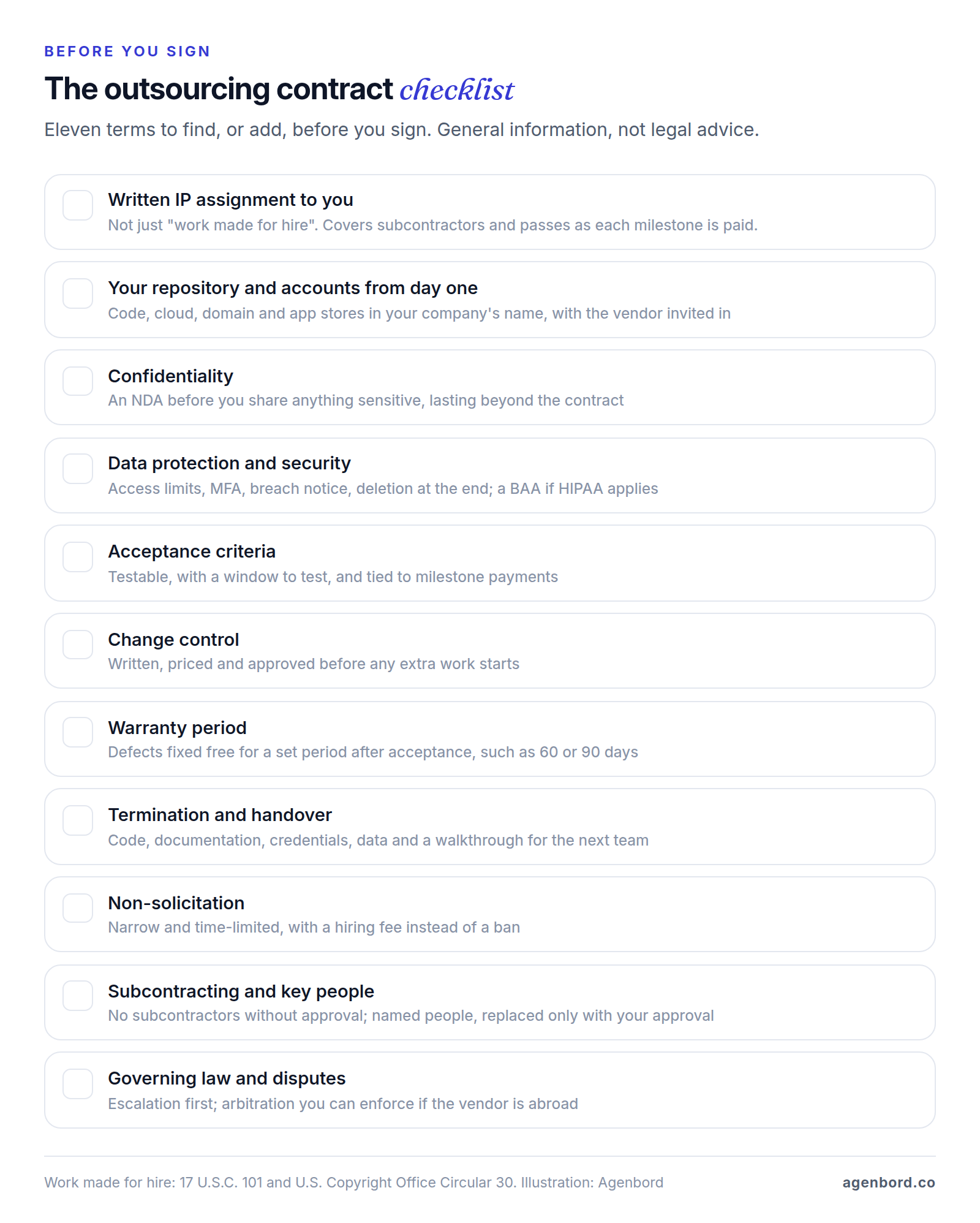
This is general information, not legal advice. Have an attorney review the agreement, especially if the vendor is based outside the US.
IP assignment: why "work made for hire" isn't enough
Under US copyright law, code belongs to its author unless it's a work made for hire or the rights are transferred in writing. When an outside vendor builds your software, the author is the vendor, or a freelancer it hired, not you. 17 U.S.C. 101 defines a work made for hire two ways: an employee's work within the scope of the job, or a specially commissioned work in one of nine categories (a contribution to a collective work, part of a film or other audiovisual work, a translation, a supplementary work, a compilation, an instructional text, a test, answer material for a test, or an atlas), and then only with a written agreement signed by both sides. The Copyright Office's Circular 30 is plain: a work that fails those requirements is not a work made for hire.
Custom software isn't on the list, so a contract that only says "all work is made for hire" can leave the vendor owning your code. You need an explicit assignment of all rights in the code and other deliverables, and under section 204(a) a transfer of copyright ownership must be in writing and signed by the owner. Also cover:
- When rights pass. Assignment as each milestone is paid means you own what you've paid for if the project stops halfway.
- The vendor's existing code: a permanent, royalty-free license to any of its libraries built into your software.
- Open-source components, listed with their licenses.
- AI coding tools. The Copyright Office concluded in January 2025 that AI output is protected only where a human author has determined sufficient expressive elements, though using AI to assist doesn't bar protection. Ask which tools the team uses, and require settings that keep your code out of their training data.
The rest of the checklist
- Repository and admin access from day one. The code repository, cloud account, domain and app store accounts are created in your company's name and the vendor is invited in, so you can remove access in minutes if you need to.
- Confidentiality. A non-disclosure agreement before you share anything sensitive, covering business information, data and code, and outlasting the contract.
- Data protection and security. Which data the vendor can reach and from where, MFA on every account, test data instead of real customer data where possible, breach notice within a set number of hours, and deletion at the end. If you're covered by HIPAA, a vendor that handles patient data for you is a business associate and needs a business associate agreement. Businesses covered by the FTC's Safeguards Rule, including tax preparers and mortgage brokers, must spell out security expectations in their contracts with service providers.
- Acceptance criteria. Written tests for each milestone, a set number of days for you to test, and payment tied to acceptance. Watch for clauses that treat silence as acceptance.
- Change control. Scope changes go through a written request showing the price and schedule impact, approved by a named person before work starts.
- Warranty period. Defects (anything that fails the agreed criteria) fixed at no charge for a set period after acceptance, such as 60 or 90 days.
- Termination and handover. Your right to end the contract with notice, paying for accepted work, and a defined handover: code, documentation, credentials, data and a walkthrough for whoever takes over.
- Non-solicitation. Expect the vendor to ask you not to hire its people. Keep it narrow (people who worked on your project, for a fixed period), with a fee that lets you hire someone rather than an outright ban.
- Subcontracting and key people. No subcontractors without your written approval, the same IP and confidentiality terms passed down to them, and named key people who are replaced only with your approval.
- Governing law and disputes. Which law applies, where disputes are heard, and an escalation step before that. With a vendor based abroad, arbitration is often easier to enforce than a court judgment.
Red flags and questions to ask when outsourcing software development
Our guide on how to choose a software development company covers general vetting: working software, references and comparing quotes against one scope. Before you sign with any of the software development outsourcing companies on your shortlist, add these checks.
Red flags:
- They won't say where your developers work, or whether they're employees or subcontractors.
- Their contract relies on "work made for hire," and they resist adding a written assignment.
- Disputes can only go to the vendor's home courts, under its law.
- Most of the price is due before you see working software.
- "We reply within 24 hours" is their whole plan for a build that needs decisions every day.
- They won't do a paid pilot or let an independent developer review the code.
- They want production data or shared admin passwords in the first week.
Questions to ask before signing:
- Where will each person on our project work, and who employs them?
- Which hours will overlap ours, and how do questions get answered outside them?
- Which legal entity signs the contract, where is it registered and which law governs it?
- Can we see a sample statement of work, with acceptance criteria, from a past project?
- What will we see each week? The answer you want: working software on a staging environment you can log into.
- How do you estimate, and what happens when an estimate turns out wrong?
- How is code reviewed and tested before we see it?
- Which AI coding tools do you use, and how do you keep our code out of their training data?
- What does handover include if we part ways?
How to run a paid pilot or discovery phase
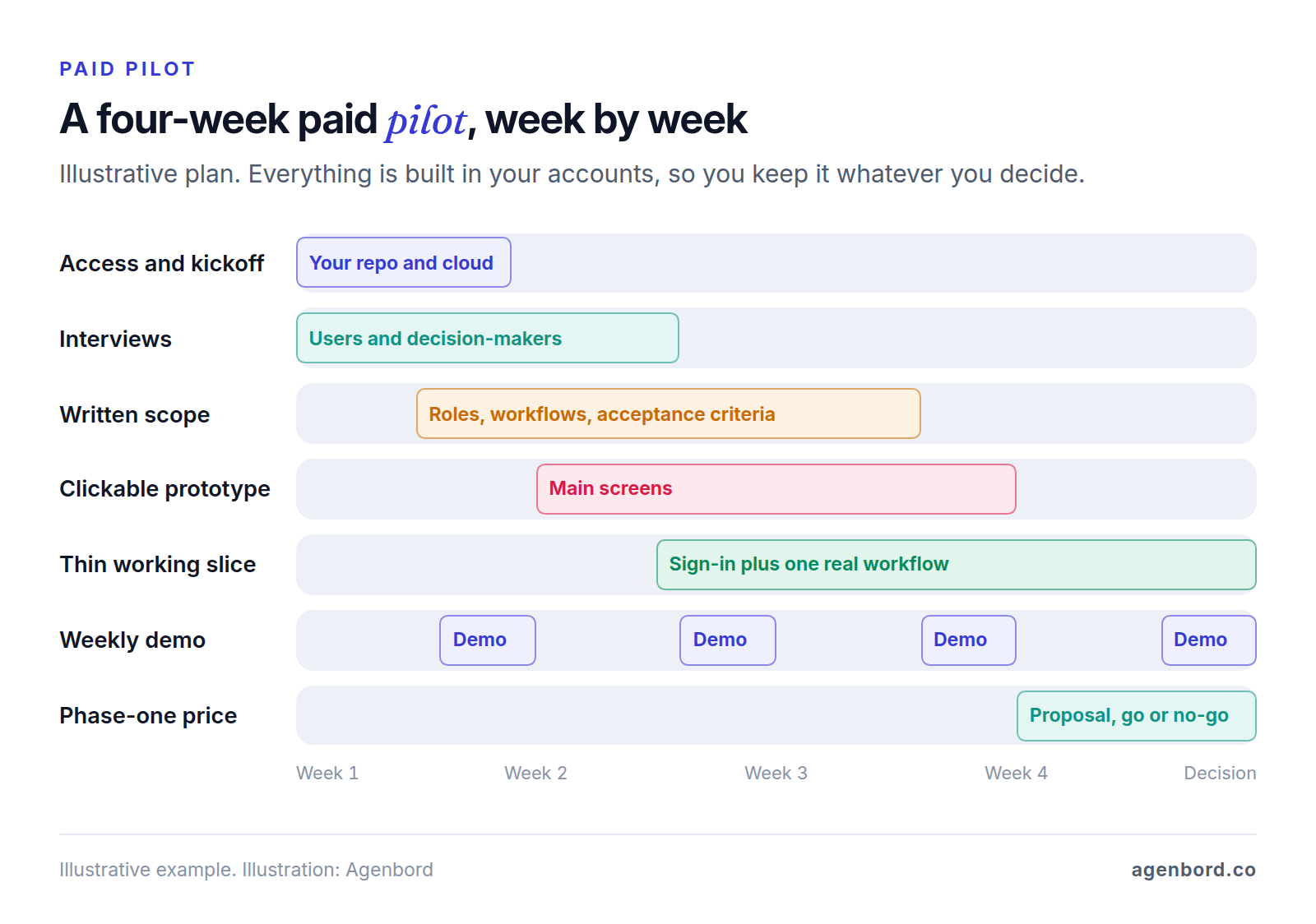
Before you sign a big contract, buy two to four weeks of the vendor's time at a fixed price with defined deliverables. You see how they work on your problem, and you keep what they produce either way. A pilot should deliver:
- A written scope for phase one (roles, workflows, screens, integrations and acceptance criteria) that another vendor could price.
- A clickable prototype of the main screens, reviewed by the people who'll use them.
- Architecture notes: the main technology choices, the data model and the hosting plan, in plain English.
- A thin working slice, such as sign-in plus one real workflow, built in your repository and running on a staging environment in your cloud account.
- A risk list and a phase-one price, fixed or as a range, with its assumptions.
To judge it, ask:
- Did a demo happen every week, on a staging environment you could use yourself?
- Did their questions change the plan? A vendor that pushes back on a feature is thinking about your business.
- Could you hand the scope to another vendor? If not, it isn't precise enough to fix a price.
- Is the code sound? Pay an independent developer for a few hours to review its structure, tests, documentation and setup instructions.
- How did they handle a change? Ask for one small change mid-pilot: do you get a written request with a price, or a silent yes?
- Do you understand and accept the assumptions behind the phase-one price?
If most answers are yes, sign phase one. If not, you leave with a scope and a prototype you own.
How to manage an outsourced development team week to week
Outsourcing moves the building, not the decisions. Name one person on your side, the product owner, with time every week to answer questions within the overlap window, set priorities and accept finished work. Then keep a routine:
- Written specs. Every task starts as a short description with acceptance criteria in a shared tracker. If it isn't written down, it isn't agreed.
- A weekly demo of working software, not slides or screenshots, which you then click through yourself.
- A staging environment: a private copy of the application, set up like the live one, where you test each week's work before customers see it.
- Code review. A second developer reviews every change before it's merged, with the history in your repository. If no one on your side reads code, an occasional independent review is worth paying for.
- Documentation as you go: setup instructions, architecture notes, a list of every account and integration, and how to deploy and roll back, kept in the repository.
- A short weekly written update: what's done, what's next, what's blocked, which decisions are needed from you and, on time and materials, hours used against the budget.
A month in, the routine tells you more than any contract clause. Slipping demos, unanswered questions and a staging environment you can't log into are the early warnings. Raise them in writing while they're still cheap to fix.
Sources
- U.S. Bureau of Labor Statistics - Occupational Outlook Handbook, Software Developers, Quality Assurance Analysts, and Testers: Pay (accessed October 2026)
- U.S. Bureau of Labor Statistics - Employer Costs for Employee Compensation, June 2026 (accessed October 2026)
- U.S. Bureau of Labor Statistics - ECEC Table 4, Private industry workers by occupational and industry group (accessed October 2026)
- U.S. Copyright Office - Circular 30, Works Made for Hire (accessed October 2026)
- U.S. Copyright Office - Title 17, Chapter 1, section 101 definitions (accessed October 2026)
- U.S. Copyright Office - Title 17, Chapter 2, sections 201 and 204 (accessed October 2026)
- U.S. Copyright Office - Copyright and Artificial Intelligence, Part 2: Copyrightability, January 29, 2025 (accessed October 2026)
- U.S. Department of State - Enforcement of Judgments (accessed October 2026)
- UNCITRAL - Status of the Convention on the Recognition and Enforcement of Foreign Arbitral Awards, New York 1958 (accessed October 2026)
- U.S. Department of Justice, National Security Division - Data Security Program (accessed October 2026)
- eCFR - 28 CFR 202.205, bulk thresholds (accessed October 2026)
- eCFR - 28 CFR 202.401, restricted transactions (accessed October 2026)
- eCFR - 28 CFR 202.601, countries of concern (accessed October 2026)
- HHS - Business Associates (accessed October 2026)
- Federal Trade Commission - FTC Safeguards Rule: What Your Business Needs to Know (accessed October 2026)
- NIST - Daylight Saving Time (accessed October 2026)
- EUR-Lex - Directive 2000/84/EC on summer-time arrangements (accessed October 2026)
- IANA - Time Zone Database release notes, through release 2026e (accessed October 2026)
Prices, plans and regulations change. Figures were checked on October 2, 2026; follow the links for the latest. Nothing here is legal, tax or financial advice.
About the author
Founder, Agenbord
Muhammad Hamza is the founder of Agenbord, the Fort Lauderdale software company behind the construction ERP Smart Construction and a WhatsApp-first billing platform. He writes practical guides on buying, building and automating business software.