On this page
- The subcontractor lifecycle: what software should handle at each step
- Pay applications, retainage and lien waivers
- Subcontractor compliance tracking: alerts, payment holds and an audit trail
- What a lapsed COI or missing waiver can cost: a hypothetical
- Subcontractor management software comparison: tools by type
- Free subcontractor management software: what's genuinely free
- How to choose subcontractor management software
- Build vs buy: when a custom subcontractor portal or integration pays off
If you run your subs on a spreadsheet, an inbox full of insurance certificates and a folder of lien waivers, you know where it breaks: a certificate expires mid-job, a supplier you've never dealt with sends a notice, or a pay app gets approved without its waiver.
Subcontractor management software exists to close those gaps. It tracks each sub from prequalification to the final waiver: qualification, insurance and tax documents, subcontracts and change orders, pay applications with retainage, lien waivers and closeout. The feature that matters most is a rule, not a screen: no current paperwork, no payment.
Expect to assemble that from more than one product: a construction platform such as Procore or Autodesk's tools for subcontracts, change orders and pay apps; a tracker for certificates of insurance (COIs); and a payment or waiver tool that releases unconditional waivers when the money moves. As of October 2026, most of the tools in this guide sell by quote, and one COI tracker, BCS, is free for up to 25 vendors.
We build software for contractors, including our own construction ERP with subcontractor ledgers. Here's what to require at each step, how compliance tracking should work, what the tools cost, what's free and when building pays off.
The subcontractor lifecycle: what software should handle at each step
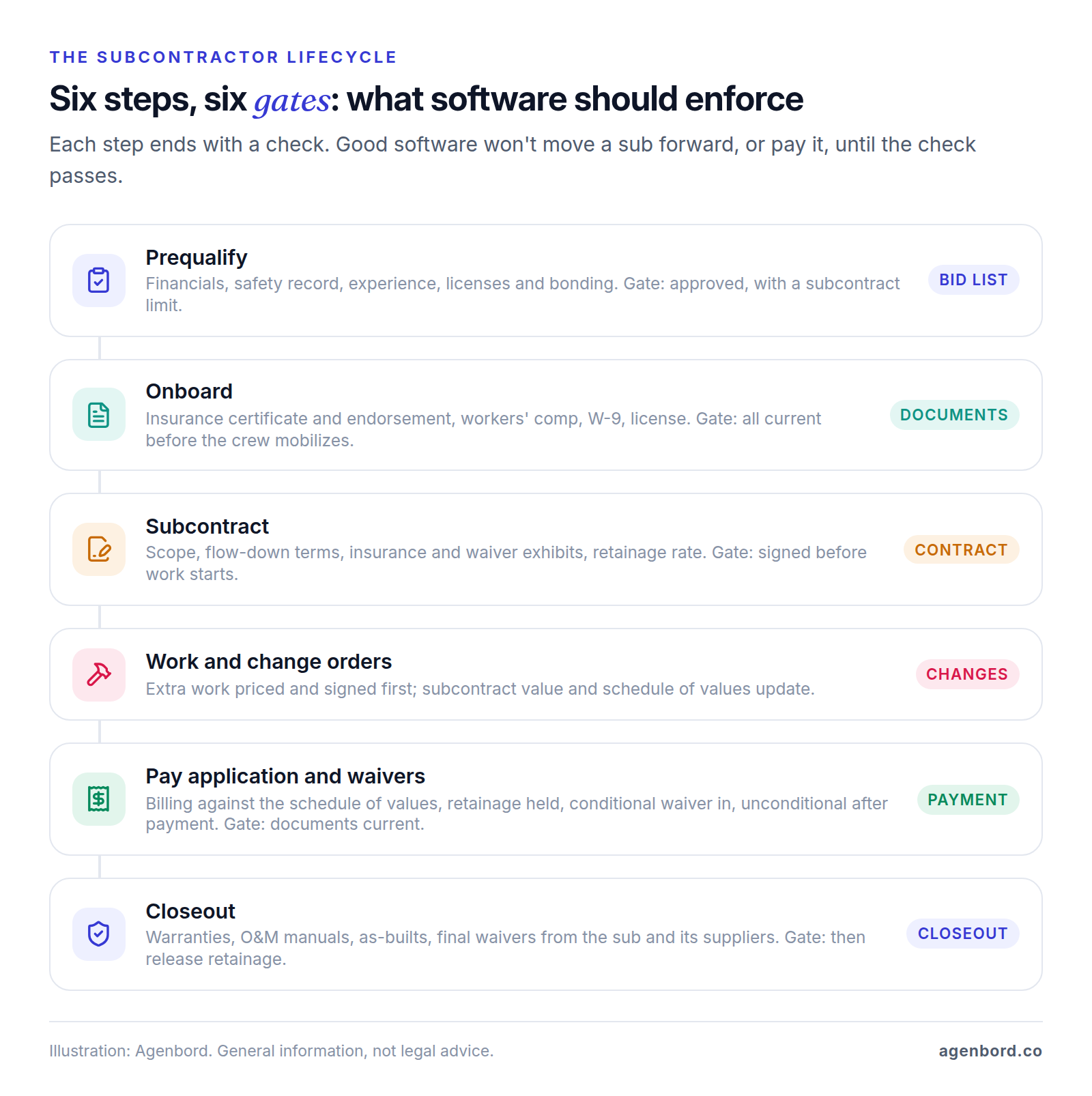
Every sub moves through the same six steps, and each one ends at a gate. Construction subcontractor management software earns its keep at those gates: a sub can't be invited to bid until it's qualified, can't mobilize until its documents are in, and can't be paid while a certificate or waiver is missing. Payment gets its own section below.
Prequalification
Prequalification decides who gets invited to bid, and for how much. Ask for:
- Financial strength: reviewed or audited financial statements, working capital, backlog and a bank reference.
- Safety record: the workers' comp experience modification rate (EMR), the safety program and injury logs. OSHA requires many employers with more than 10 employees to keep Forms 300, 300A and 301, so ask for three years of 300A summaries.
- Experience: comparable projects by size and type, with references you actually call.
- Licensing: the contractor or trade license, checked on the state's lookup. California's Contractors State License Board, for example, shows license status by number or business name.
- Bonding: a surety letter with single-project and aggregate limits, if you'll require bonds.
Software should send one questionnaire through a portal, score the answers against your criteria, record an approved limit for each sub (the largest subcontract you'll award it) and expire the approval yearly, so estimators only see current subs. Procore's prequalification module, Autodesk's TradeTapp and Highwire are built for this step.
Onboarding documents
Before a crew sets foot on site, collect the sub's insurance, tax and license documents. Three items deserve more care than they usually get.
The additional insured endorsement. A COI summarizes the sub's policies; it isn't the policy. New York's insurance law, for one, says a certificate can't amend, extend or alter the policy's coverage or confer rights beyond it. The endorsement is the policy page that makes you an insured, so get a copy and check that it covers the work you hired the sub to do.
Workers' comp. Florida requires a contractor to get evidence of workers' comp from its subs, and makes the contractor liable for comp to a sub's employees if the sub hasn't secured coverage (Florida Statutes 440.10). Florida's Division of Workers' Compensation runs a public proof-of-coverage search by employer name or federal employer ID; check whether your state offers one.
Form W-9. The W-9 gives you the sub's legal name, taxpayer identification number (TIN) and entity type for information returns. For tax years beginning after 2025, the threshold for reporting nonemployee compensation on Form 1099-NEC is $2,000, up from $600, and the IRS says it may be adjusted for inflation beginning in calendar year 2027 (1099-NEC instructions). Payments to most corporations aren't reportable, so the entity type matters. If a sub doesn't give you a correct TIN, the IRS requires backup withholding of 24% on its reportable payments.
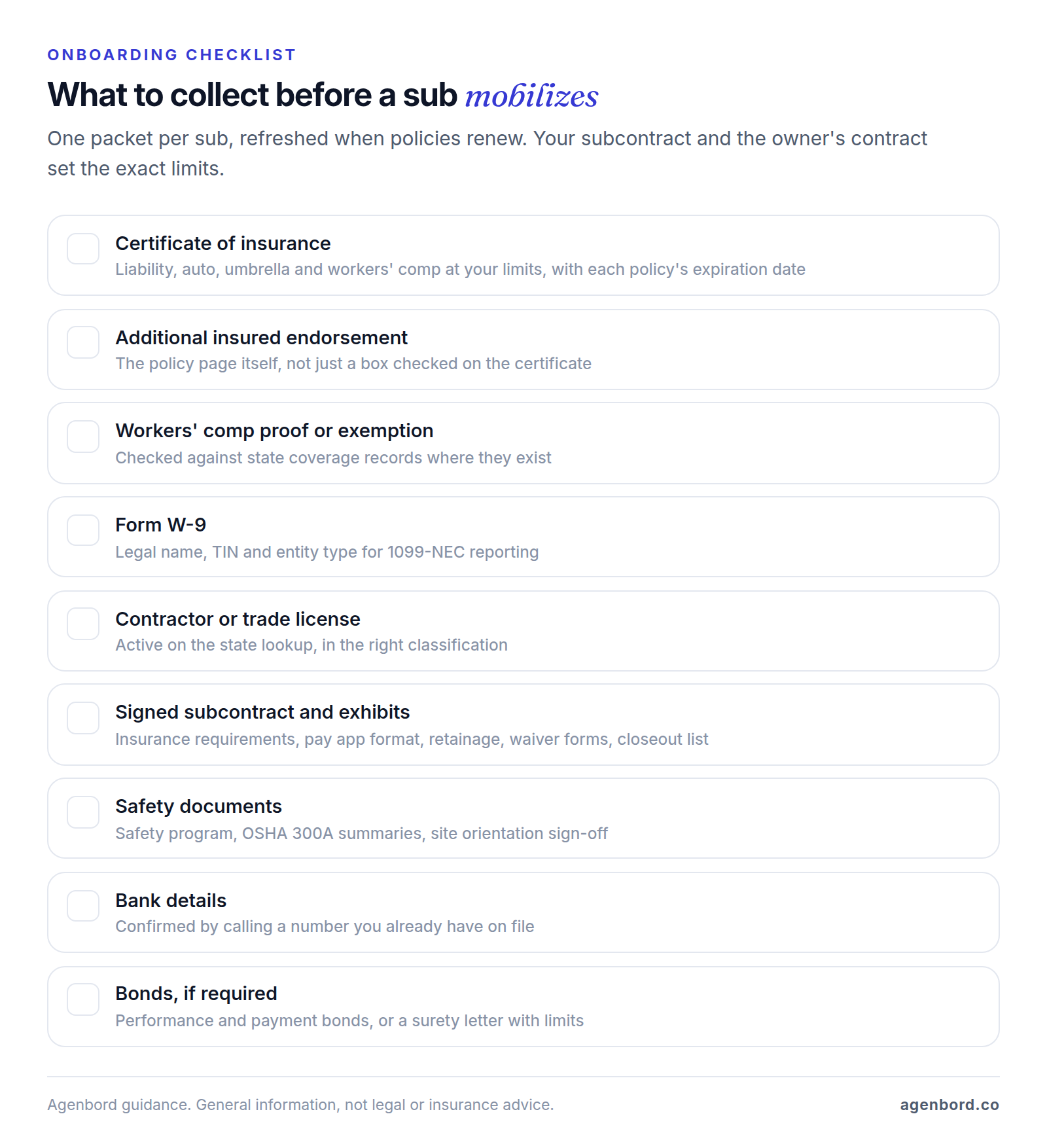
Software should store requirements by job (an owner's contract can raise the limits), track an expiration date for each policy rather than each certificate, request renewals from the sub and its insurance agent, and keep every version.
Subcontract and flow-down terms
The subcontract sets the rules your software will enforce. Its flow-down clause passes down the prime contract obligations that touch the sub's work (insurance, schedule, safety, warranty and paperwork), and its exhibits should spell out what the system will check: insurance requirements, pay application format and due date, retainage rate and release terms, required waiver forms and closeout deliverables.
Software should build the subcontract from a template with those exhibits, collect e-signatures and turn the signed amount and schedule of values into a commitment in your job cost, so committed cost is right from day one. Our guide to construction job costing software shows why that number drives your forecast.
Work and change orders
Extra work should be priced and signed before it starts. Tie each sub change order to the owner change that caused it, so you can see which costs you'll recover and which you'll absorb. When a change is approved, the software should update the subcontract value, the schedule of values the sub bills against and your committed cost, and it should keep pending changes visible but out of billing.
Closeout
Closeout is your last point of leverage, because you still hold the retainage. For each sub, track warranties, operation and maintenance (O&M) manuals, as-built markups, punch list sign-off and final waivers from the sub and its suppliers. Software should hold the retainage release until that list is complete.
Pay applications, retainage and lien waivers
Pay applications and retainage
Subs usually bill monthly against a schedule of values, often on AIA-style forms: the G702 application and certificate for payment, and the G703 continuation sheet that breaks the contract sum into line items. Your project manager checks percent complete against the field, you hold retainage (the share of each payment held back until the work is accepted) at the subcontract rate, and approved sub billings roll up into your own pay app to the owner.
Software should carry prior billings and approved change orders forward, calculate retainage line by line, handle a retainage reduction partway through a job, keep a retainage payable ledger for each sub and route approvals. Oracle Textura, for example, generates G702/703 documents linked to each contract's schedule of values and rolls subcontractor invoices into the GC's owner billing.
Lien waivers: conditional vs unconditional, progress vs final
A lien waiver is a written release of lien rights, and in some states payment bond rights, in exchange for payment. Two questions define every waiver:
- Conditional or unconditional? A conditional waiver takes effect only when the payment clears. An unconditional waiver is effective once signed, whether or not the money arrives.
- Progress or final? A progress waiver covers work through a date. A final waiver covers the whole subcontract.
Some states write the forms into law. Arizona's A.R.S. 33-1008 sets four forms (conditional and unconditional, for progress and final payments), makes a waiver effective only if it substantially follows one of them, and requires the unconditional forms to warn that the document "is enforceable against you if you sign it, even if you have not been paid." Florida's section 713.20 sets progress and final forms, bars anyone from requiring a different form, makes advance waivers unenforceable and lets the signer condition a waiver on payment of the check. Its progress form doesn't cover retention or work after the through-date.
That gives you the standard exchange. The sub sends a conditional progress waiver with its pay app, you pay, and the unconditional waiver for that payment arrives before the next one. The final waiver comes with the retainage. Software should pick the right form for the job's state, prefill amounts and through-dates from the pay app, collect e-signatures, match each unconditional waiver to a cleared payment and hold the next payment when one is missing. Procore Pay, for example, stages signed unconditional waivers and releases them only after payment is complete.
Sub-tier suppliers, notices and joint checks
Your subs' suppliers and sub-subs usually have lien rights too, though you never hired them. In Florida, most lienors without a direct contract with the owner must serve a notice to owner no later than 45 days after they start furnishing, and at final payment the contractor gives the owner an affidavit stating whether lienors who served a notice have been paid (section 713.06). Every notice you receive names a party whose waiver you'll need.
Software should log each notice, link the sender to the sub it supplies and require that party's waiver before releasing the sub's payment. When a supplier is at risk of going unpaid, a common fix is a joint check made out to both the sub and the supplier; record the joint check agreement and collect a waiver from each payee. Textura can also pay sub-tiers directly where required.
This is general information, not legal advice. Lien rules vary by state, so set up your forms and payment rules with a construction attorney.
Subcontractor compliance tracking: alerts, payment holds and an audit trail
Compliance tracking comes down to three rules, applied the same way every time:
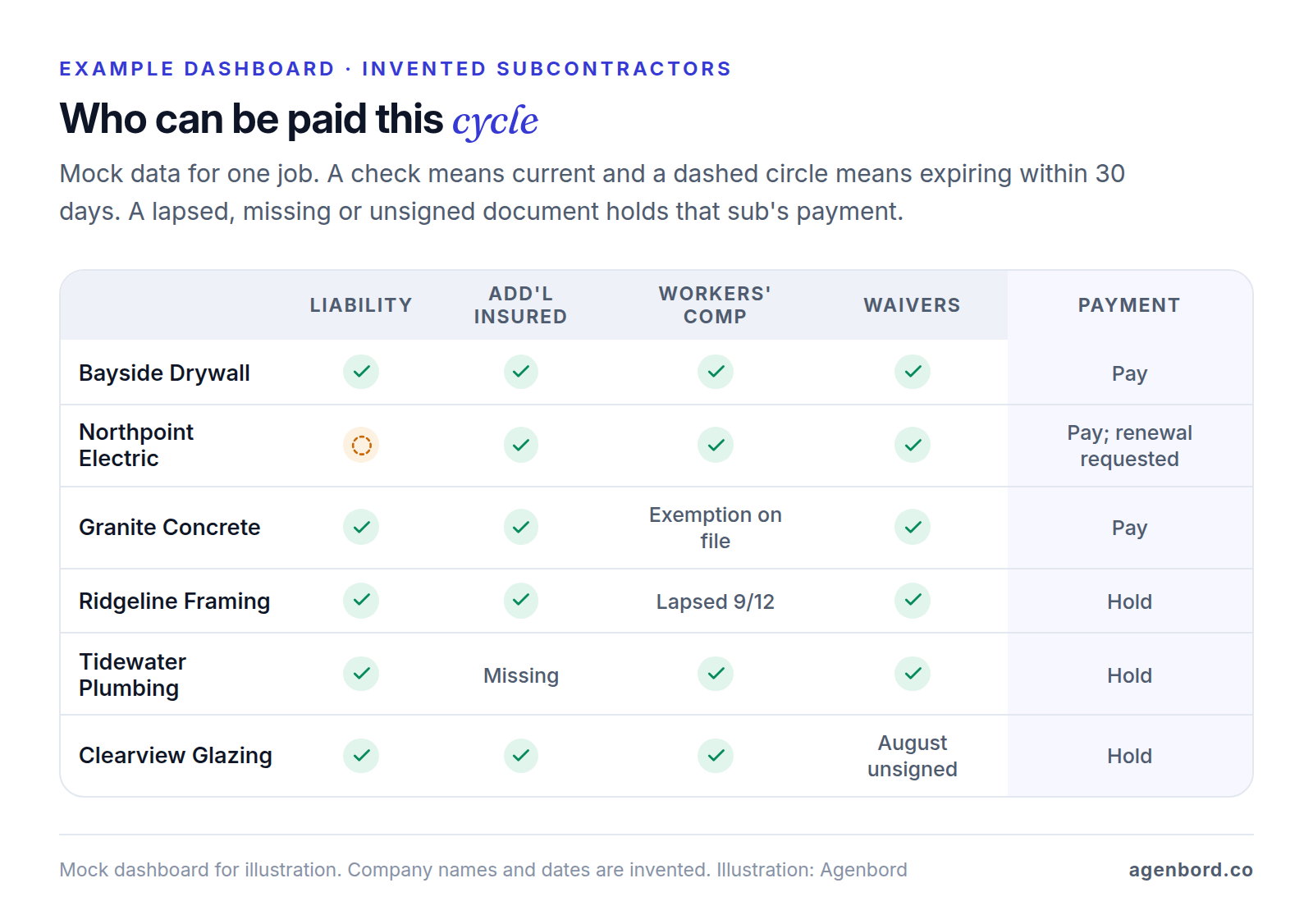
- Alert before anything expires. Request a renewal from the sub and its insurance agent 30 days out, remind the project manager at 7 days, and tell accounts payable the day a document lapses.
- Hold payment when a requirement isn't met. An expired policy, a missing endorsement or an outstanding unconditional waiver puts that sub's next payment on hold. The hold has to live where checks are cut: if your project platform tracks compliance and your accounting system pays, connect them. Overrides will happen, so require a named approver and a reason.
- Keep an audit trail. Record who received and reviewed each document, which version was current on each payment date, and who approved or overrode each payment. Procore Pay's audit trail, for example, shows who reviewed and approved each disbursement.
Here's the tracker those rules run on. It doubles as the column list for a spreadsheet version.
| Requirement | Check when it arrives | Refresh | If it lapses or is missing |
|---|---|---|---|
| Liability, auto and umbrella COI | Limits, policy dates and certificate holder match the subcontract | At each policy renewal; request 30 days ahead | Hold payment |
| Additional insured endorsement | The endorsement itself is attached and covers the sub's work | At each renewal | Hold payment |
| Workers' comp, or exemption | Covers the job's state; exemption on file if claimed | At each renewal | Hold payment and keep the crew off site |
| Form W-9 | Name, TIN and entity type complete; TIN matched | When the name, entity or TIN changes | Don't pay until it arrives, or backup withhold |
| License | Active, in the right classification, on the state lookup | Before each award and at renewal | No new awards |
| Lien waivers | Right form, amount, through-date and signature, including sub-tiers | Every payment | Hold the next payment |
| Certified payroll (Davis-Bacon jobs) | The sub's own payroll information for every week worked | Weekly | Hold payment |
| Prequalification | The approved limit covers this subcontract | Yearly | No bid invitations |
What a lapsed COI or missing waiver can cost: a hypothetical
Here's how two small slips get expensive. The example is hypothetical, and every number in it is an assumption.
A GC is building a medical office in Florida. In September it pays its framing sub's $90,000 August pay app. Two things had slipped:
- The sub's lumber yard served a notice to owner in June, but nobody asked for the yard's waiver. Short on cash, the sub never pays the yard's $32,000 invoice, and the yard records a lien.
- The sub's workers' comp policy was canceled in July, while the certificate in the GC's file still shows a December expiration date. A carpenter is injured in September.
| What slipped | What happens next | What it costs the GC |
|---|---|---|
| Sub-tier waiver never collected | The owner holds the GC's next draw until the lien is released. The GC pays the yard to get the release, then tries to recover the money from its sub. | $32,000 paid twice for the same lumber, plus a lien bond or legal fees, plus the cost of a held draw |
| Workers' comp canceled mid-term | Under Florida Statutes 440.10, the GC is liable for comp to the sub's injured employee, because the sub hadn't secured coverage. | The medical and wage benefits the sub's policy should have paid |
Two lessons. A certificate shows the expiration date on the day it was issued, not a later cancellation, so recheck coverage before large payments, using your state's records where they exist. And prevention is cheap by comparison: at BCS's October 2026 list price for self-service tracking ($11.40 per vendor per year), 60 active subs cost $684 a year, and requiring waivers from every party that served a notice costs nothing but discipline.
Subcontractor management software comparison: tools by type
There's no single best subcontractor management software. The right choice depends on the platform and accounting system you already run and on which gap costs you most. Here are the main options by type, with prices from each vendor's own site as of October 2026.
| Tool | What it covers | Price as of October 2026 | Check before you buy |
|---|---|---|---|
| Procore (construction platform) | Prequalification, bid management, subcontracts and change orders, sub invoices with retainage, insurance records with expiration notices; Procore Pay for payments and waivers | Annual contract priced on construction volume, unlimited users; Procore Pay pricing isn't published | Whether an expired policy blocks a payment or only sends a notice |
| Autodesk BuildingConnected Pro, TradeTapp and Forma Build (construction platform) | Bidding; prequalification with financial and safety reviews; contracts, change orders and payment applications in Forma Build | BuildingConnected Pro and TradeTapp by quote; Forma Build listed from $117 a month | Cost tools are in Forma Build, not the Essentials tier; ask how users are counted |
| Highwire (prequalification and safety) | Prequalification of experience, capacity, finances and safety; insurance requirements | Quote, with a free trial for clients; contractor subscriptions priced on headcount | Who pays: you, your subs or both |
| illumend from myCOI (insurance compliance) | AI review of certificates and endorsements, outreach to subs, renewal tracking | Quote | Integration with your project and accounting tools |
| BCS (insurance compliance) | COI tracking, automated requests and deficiency notices; integrations from Self-Service up | Free for up to 25 vendors; $0.95 per vendor a month, billed annually; Full-Service $17.80 per vendor a year with a $10,000 minimum | The free plan's 25-vendor cap |
| Jones (insurance compliance) | COI intake and gap detection, renewal alerts, audit trails; optional expert outreach | Quote, based on records per year | Procore and CMiC sync is an optional add-on |
| Oracle Textura (payments and waivers) | G702/703 pay apps, conditional and unconditional waivers including sub-tiers, compliance documents, ACH payments | Quote | What, if anything, your subs pay to bill you |
| GCPay (payments and waivers) | Online progress billing, required documents at submission, approval routing | Not published | Which accounting systems it connects to |
| Siteline (billing for subs) | Pay apps in each GC's format, lower-tier waivers, COI tracking | Custom quote; unlimited users | A sub-side tool: ask which of your subs bill through it |
Construction platforms
If your jobs already run in Procore or Autodesk, start there: subcontracts, change orders and pay apps live in the same record as the project. Procore's company directory stores each vendor's policies with limits, expiration dates and an additional insured field, and notifies designated insurance managers when policies are about to expire. Autodesk splits the work across BuildingConnected Pro, TradeTapp and Forma Build; its old Autodesk Build product page now redirects to Forma Build.
Specialist tools
Prequalification tools earn their cost on larger scopes and bonded work: TradeTapp, for example, centers on custom questionnaires, automated financial reviews, limit calculations and risk scoring. COI trackers get compliant certificates and endorsements in and keep them current. illumend checks additional insured status, waivers of subrogation, primary and non-contributory wording and per-project aggregates line by line, and BCS and Jones both offer service tiers where their staff chase deficiencies for you.
Payment platforms tie the waiver to the money. Textura exchanges e-signed unconditional waivers for ACH payments, and Oracle says it sets up integrations with systems such as CMiC, Sage, Viewpoint, NetSuite and Acumatica at no extra charge. GCPay lets you require documents with each billing, and Levelset, which also handles lien notices and filings, offers a waiver inbox, e-signatures and templates for every state. Every one of these is another system your subs must use, so ask what onboarding subs get and test the connection to whatever pays them.
Check your construction ERP before you buy anything, too: Acumatica's Construction Edition, for example, manages lien waivers and insurance certificates with expiration alerts. Our construction ERP guide compares those systems.
Free subcontractor management software: what's genuinely free
Free tools go a long way for a short sub list, as long as one person owns the process.
- A spreadsheet tracker. One row per sub and requirement, using the tracker table above plus policy number, limits, date requested, date received and reviewer. Add a pay status column that accounts payable checks before every payment run, and use conditional formatting to flag anything expiring within 30 days.
- Statutory waiver forms. Where a state writes the forms into law, the statute is your template: Arizona's are in A.R.S. 33-1008 and Florida's in section 713.20. Levelset also publishes free lien waiver forms for all 50 states.
- BCS's free plan. COI tracking with automated requests and deficiency notices for up to 25 vendors. Integrations, unlimited users and support start on the paid Self-Service plan.
- Public lookups. State license searches, Florida's workers' comp coverage search and, for payers that file information returns, IRS TIN Matching to check a sub's name and TIN before you file.
What free doesn't give you is enforcement: holds that stop a check, endorsement review, sub-tier waiver tracking and an audit trail you'd be comfortable showing a judge or an auditor. Once you have more than about 25 active subs, more than one person approving payments, or one lien or uninsured-claim scare, it's time to pay for a tracker.
How to choose subcontractor management software
Start from what you run today:
- Around $5M–$20M a year, on QuickBooks and spreadsheets: a COI tracker (free or self-service), statutory or attorney-approved waiver forms collected by e-signature, and a hold column accounts payable checks every run. When change orders start slipping, add a project management tool with subcontracts; our construction project management software guide compares them.
- Around $20M–$100M, on Procore or Autodesk plus a construction ERP: use the platform for subcontracts, change orders and pay apps, then add a payment-and-waiver tool, a dedicated COI tracker if the platform only sends notices, and prequalification if you do bonded or public work.
Then run the same tests on every finalist, with your own jobs and at least one real sub:
- Expired certificate. Approve a pay app for a sub whose liability policy expired yesterday. Does the system block it, warn you or let it through?
- Waiver exchange. Submit a pay app with a conditional waiver, mark it paid and watch for the unconditional request. Are the amount and through-date filled in?
- Sub-tier waiver. Add a supplier that served a notice. Can you require its waiver before paying the sub?
- Change order. Approve a sub change order. Do the subcontract value, schedule of values and committed cost all update?
- Retainage. Cut retainage from 10% to 5% at 50% complete, then release it at closeout against final waivers.
- The hold reaches accounts payable. Put a sub on hold, then try to pay it from your accounting system. If the check still prints, the hold is decoration.
- Sub experience. Have a sub upload a certificate and sign a waiver from a phone, without a paid seat.
Build vs buy: when a custom subcontractor portal or integration pays off
Buy first. The platforms above already model subcontracts and pay apps, and as the example above shows, dedicated COI tracking for 60 subs can cost under $1,000 a year. Custom work pays off in four situations:
- The hold can't reach the system that pays. Compliance lives in one tool, checks come out of another, and no connector exists. A one-way workflow automation, such as flagging a vendor in accounting when its certificate expires, starts from $1,500 (1–2 weeks). A two-way integration is quoted per integration.
- Your rules don't fit a tracker. Think owner-specific insurance requirements on every job, wrap-up insurance programs, or union and prevailing-wage paperwork. A focused internal compliance tool is custom software from $12,000 (4–8 weeks).
- You want one portal for subs. One login to bid, onboard, upload certificates, submit pay apps and sign waivers, feeding your project and accounting systems. We scope that like a customer portal: $25,000–$60,000 (8–14 weeks).
- Sub management belongs inside your own ERP. A single ERP module starts from $25,000 (2–4 months).
Budget hosting at roughly $50–$500 a month and maintenance at about 15–20% of the build cost a year. Our build vs buy framework covers the rest of the decision.
Smart Construction, the cloud construction ERP our team designed, built and operates as a subscription SaaS, shows the single-system version of that last option: its procurement and subcontractor ledgers and progress billing with retention share one data model across web, desktop and mobile apps, and payment approvals reach decision-makers on WhatsApp. It shows what the single-system approach looks like in practice.
Sources
- IRS - About Form W-9, Request for Taxpayer Identification Number and Certification (accessed October 2026)
- IRS - Instructions for Forms 1099-MISC and 1099-NEC, revised 12/2026 (accessed October 2026)
- IRS - Instructions for Forms 1099-MISC and 1099-NEC, Rev. April 2025 (accessed October 2026)
- IRS - Backup withholding (accessed October 2026)
- IRS - Taxpayer Identification Number (TIN) Matching (accessed October 2026)
- Arizona Legislature - A.R.S. 33-1008, Waiver and release of lien; forms (accessed October 2026)
- Florida Legislature - 2026 Florida Statutes 713.20, Waiver or release of liens (accessed October 2026)
- Florida Legislature - 2026 Florida Statutes 713.06, Liens of persons not in privity (accessed October 2026)
- Florida Legislature - 2026 Florida Statutes 440.10, Liability for compensation (accessed October 2026)
- Florida Department of Financial Services, Division of Workers' Compensation - Proof of Coverage search (accessed October 2026)
- New York State Senate - Insurance Law Section 502, Prohibitions (certificates of insurance) (accessed October 2026)
- OSHA - Injury and Illness Recordkeeping and Reporting Requirements (accessed October 2026)
- California Contractors State License Board - Check a License (accessed October 2026)
- U.S. Department of Labor, Wage and Hour Division - Form WH-347 and weekly certified payroll (accessed October 2026)
- AIA Contract Documents - Summary: G702-1992, Application and Certificate for Payment (accessed October 2026)
- Procore - Pricing (accessed October 2026)
- Procore - Pricing based on construction volume (accessed October 2026)
- Procore - Prequalification (accessed October 2026)
- Procore - Bid Management (accessed October 2026)
- Procore Support - Commitments (accessed October 2026)
- Procore Support - Add Insurance to a Company Record in the Company Directory (accessed October 2026)
- Procore Support - Designate an Insurance Manager for Your Procore Company (accessed October 2026)
- Procore - Procore Pay (accessed October 2026)
- Autodesk - Pricing for preconstruction and construction bundles (accessed October 2026)
- Autodesk - BuildingConnected (accessed October 2026)
- Autodesk - TradeTapp (accessed October 2026)
- Autodesk - Forma Build (accessed October 2026)
- Highwire - Contractor prequalification and safety (accessed October 2026)
- Highwire - Pricing (accessed October 2026)
- Highwire - Free trial (accessed October 2026)
- illumend from myCOI - Insurance compliance platform (accessed October 2026)
- BCS - COI tracking pricing (accessed October 2026)
- Jones - Pricing (accessed October 2026)
- Oracle - Textura Payment Management (accessed October 2026)
- GCPay - Internet based progress billing (accessed October 2026)
- Levelset - Lien waiver management (accessed October 2026)
- Levelset - Free lien waiver forms (accessed October 2026)
- Siteline - Construction billing for trade contractors (accessed October 2026)
- Siteline - Pricing (accessed October 2026)
- Acumatica - Construction Edition data sheet, 2026 (accessed October 2026)
Prices, plans and regulations change. Figures were checked on October 2, 2026; follow the links for the latest. Nothing here is legal, tax or financial advice.
About the author
Founder, Agenbord
Muhammad Hamza is the founder of Agenbord, the Fort Lauderdale software company behind the construction ERP Smart Construction and a WhatsApp-first billing platform. He writes practical guides on buying, building and automating business software.